

How to Run a Citizenship Study Group
For families, friends, volunteers and library staff who lead a weekly class: a 60-minute class plan, outlines for 4 to 10 weeks and an activity for every chapter.
Step 1
Choose an outline
Canada's History is the longest chapter, so it gets the most time; short chapters share a week. Each week has one discussion question from the guide's own study questions.
One chapter, or two short ones, each week
| Week | Chapters | A question from the guide |
|---|---|---|
| 1 | Applying for Citizenship; Rights and Responsibilities | Name two key documents that contain our rights and freedoms. |
| 2 | Who We Are | Who were the founding peoples of Canada? |
| 3 | Canada's History: from Aboriginal peoples to responsible government | What is meant by the term "responsible government"? |
| 4 | Canada's History: from Confederation to the Second World War | What does Confederation mean? |
| 5 | Modern Canada | What is the significance of the discovery of insulin by Sir Frederick Banting and Charles Best? |
| 6 | How Canadians Govern Themselves | What are the three branches of government? |
| 7 | Federal Elections | Who is entitled to vote in Canadian federal elections? |
| 8 | The Justice System; Canadian Symbols | What is the role of the courts in Canada? |
| 9 | Canada's Economy; Canada's Regions | What provinces are referred to as the Atlantic Provinces? |
| 10 | Practice test and review | The lessons the practice test shows |
Two or three chapters each week
| Week | Chapters | A question from the guide |
|---|---|---|
| 1 | Applying for Citizenship; Rights and Responsibilities; Who We Are | Who are the Métis? |
| 2 | Canada's History | What did the Canadian Pacific Railway symbolize? |
| 3 | Modern Canada; Canadian Symbols | Name two Canadian symbols. |
| 4 | How Canadians Govern Themselves; Federal Elections | What are the three levels of government? |
| 5 | The Justice System; Canada's Economy; Canada's Regions | What is the role of the courts in Canada? |
| 6 | Practice test and review | The lessons the practice test shows |
The whole guide, with more reading at home
| Week | Chapters | A question from the guide |
|---|---|---|
| 1 | Applying for Citizenship; Rights and Responsibilities; Who We Are | What are some examples of taking responsibility for yourself and your family? |
| 2 | Canada's History; Modern Canada | What does Confederation mean? |
| 3 | How Canadians Govern Themselves; Federal Elections; The Justice System | After an election, which party forms the government? |
| 4 | Canadian Symbols; Canada's Economy; Canada's Regions | What is the highest honour that Canadians can receive? |
In the shorter outlines, take one or two sections of each chapter in class and leave the rest for home. In a 4-week course, use the last ten minutes to plan each learner's practice test at home.
Ready-made classes: the vocabulary guide for key terms in English and French, and the worked example in the guide for helpers for the government week.
Step 2
A 60-minute class
10 min
Remember
20 min
Read and explain
20 min
Practise and check
10 min
Recall and plan
The order matters more than the minutes. Print the one-page class plan to keep in front of you.
10 min
Remember
Show two or three of last week's review questions and one from an earlier week, on the board or the screen. Everyone writes an answer alone, then compares with a partner. In the first class, ask what the group already knows about the chapter.
In a group: The question from an earlier week brings older chapters back, and anyone who missed a week picks up the thread.
20 min
Read and explain
Read one or two short sections together. Learners who read better in another language can follow the lesson in their language on their phone. Write the key words on the board in English or French.
In a group: Ask pairs to explain the main idea to each other in their own words.
20 min
Practise and check
Show or read 3 to 5 questions about today's sections, or use the chapter's activity instead. Everyone answers alone, pairs compare and say why, then everyone answers again. Before you reveal the answer, ask for a show of hands: sure or not sure? Then reveal it and find the sentence in the guide together.
In a group: Give a hint only if most of the group is stuck, so everyone tries first.
10 min
Recall and plan
Close the guides and ask two short questions about today. Each learner writes one review question for next week. Say which part of the chapter to read at home and which lesson quiz to try.
In a group: Collect the questions and pick two or three that cover today's main ideas; keep the rest for later weeks.
A longer class. For an hour and a half or two hours, run the four steps twice, on two sections, with a short break in between. Open the second round with a question on the first.
Why this order. In a study of university classes, students who answered alone, talked it over and answered again did better on a new, similar question, even when no one in their group knew the answer at first.Smith et al., 2009
Answering from memory and spreading review over weeks are among the best-supported study habits, so each class opens with earlier weeks' questions. Neither study looked at citizenship classes; the timings are a guide.Dunlosky et al., 2013
Step 3
Before each class
About ten minutes:
Sections
Choose one or two short sections
From the week's chapter in Discover Canada.
Questions
Pick 3 to 5 questions, or the activity
Questions about those sections from the chapter's lesson quiz: open its "Present to a group" view (links in the chapter table below), skim a set and note the question numbers. Or use the chapter's 10-minute activity instead.
Review
Bring the review questions
Two or three of last week's, and one from an earlier week. They open the class.
Materials
Have the guide and QR cards ready
The guide open, online or printed, and a few spare QR cards for newcomers.
Step 4
The first class
The same four steps, with three additions:
Welcome
Welcome and the test
Names, and when each person expects to take the test. Then the test in two minutes: 20 questions in English or French, based on Discover Canada, and 15 correct answers to pass.
Phones
Phones and QR cards
Hand out QR cards in each learner's language and help everyone open CitizenPro on their own phone. There is no account; progress stays on that phone.
First chapter
A short first chapter
Applying for Citizenship is the shortest chapter. Run the four steps on it, starting with "What do you already know?", and end with one review question from each learner.
Step 5
Between classes
The rest of the week's chapter happens at home, on the learner's own phone:
Read
Read the rest of the chapter
In the lesson, in the learner's own language, a section or two at a time.
Practise
Try its quiz in English or French
Without looking back, then read the explanations for the questions they missed.
Bring
Bring one hard question
A question or a word that was hard. Use one or two of them in the next class's Remember step.
No account is needed and progress stays on the phone. On a library computer, use a private window.
Step 6
The last weeks
When the chapters are covered, a full practice test shows each learner which lessons to review; use the last class for them. It follows the official format (20 questions, 45 minutes, 15 correct to pass) but does not predict the official result.
The online test. Most learners take it online and alone, with no notes or other devices. Go through the readiness checklist in the guide for helpers: device, browser, ID and a 45-minute rehearsal. The test invitation and IRCC's website are the final word.IRCC
Toolkit
Chapter activities and links
Use an activity in pairs instead of quiz questions in the Practise and check step; every answer is in the chapter. A chapter name opens its lesson; Quiz and Present open its quiz, alone or projected for the group.
| Chapter | 10-minute activity | Practise |
|---|---|---|
| Applying for Citizenship | Put in order: pass the test, receive a Notice to Appear, take the Oath, sign the oath form, receive the certificate. | Quiz · Present |
| Rights and Responsibilities | Sort into right or responsibility: mobility rights, obeying the law, serving on a jury, taking care of yourself and your family. | Quiz · Present |
| Who We Are | Name the three founding peoples of Canada, then the three groups of Aboriginal peoples. | Quiz · Present |
| Canada's History | Put in order: the War of 1812, responsible government, Confederation, the last spike of the Canadian Pacific Railway. | Quiz · Present |
| Modern Canada | Match each invention to its inventor: insulin, the telephone, the snowmobile, standard time zones. | Quiz · Present |
| How Canadians Govern Themselves | Sort into federal, provincial or municipal, with the sorting exercise in the guide for helpers. | Quiz · Present |
| Federal Elections | From memory, write the three conditions for voting in a federal election. | Quiz · Present |
| The Justice System | Who does what: the courts, the police. Then explain "innocent until proven guilty" in your own words. | Quiz · Present |
| Canadian Symbols | Match each symbol to its story: the maple leaf, the beaver, the Victoria Cross. | Quiz · Present |
| Canada's Economy | Sort into the three types of industries: banking, forestry, making paper, fishing, tourism. | Quiz · Present |
| Canada's Regions | Name the five regions, then place each province and territory in one. | Quiz · Present |
Toolkit
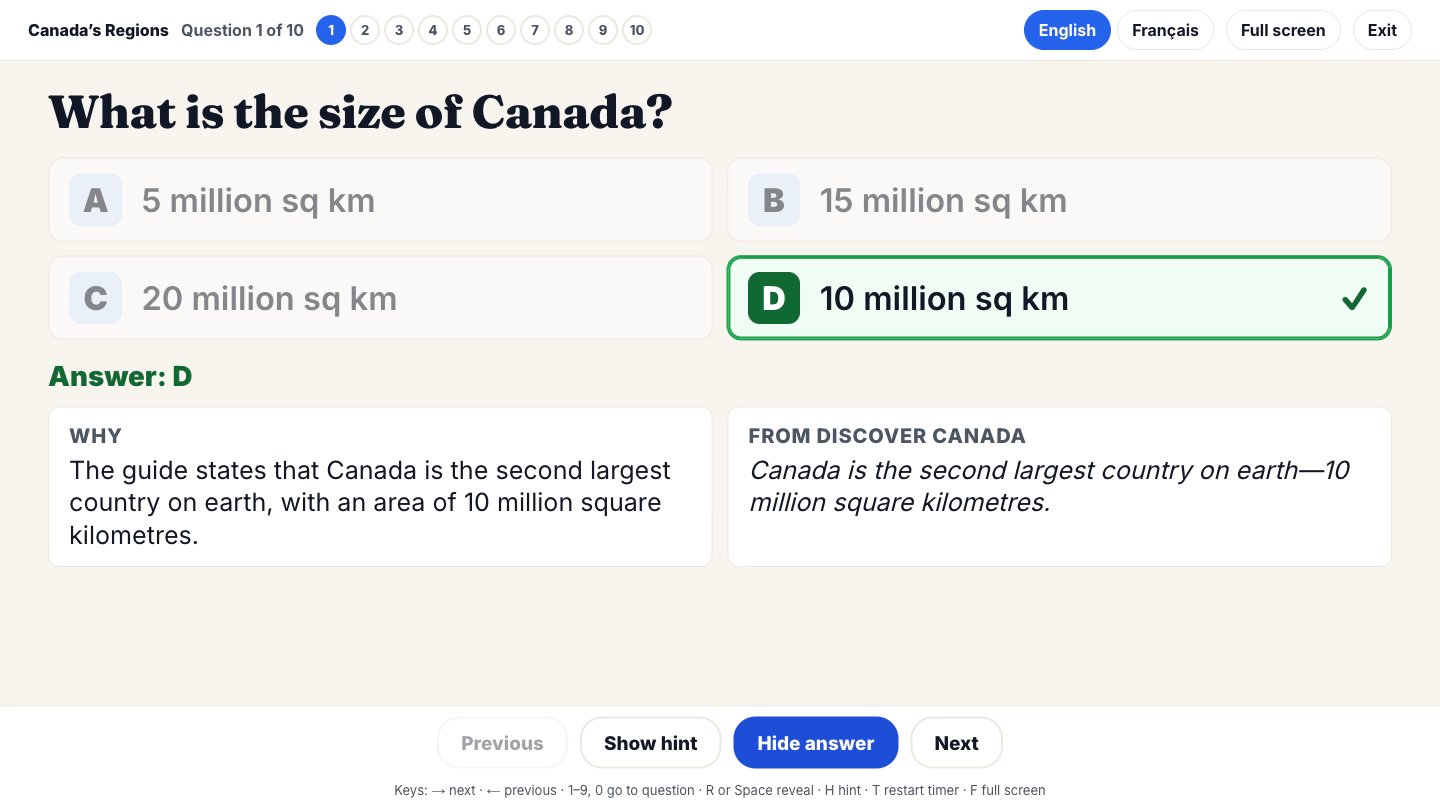
Project the questions
Use the Present links in the chapter table, or open a lesson quiz and choose "Present to a group".
- One question at a time, large enough to read across a room, in sets of ten; the numbered dots jump to the questions you chose.
- A quiet countdown gives everyone time to think before anyone answers aloud.
- The answer stays hidden until you reveal it, so the group answers, talks it over and answers again first.
- After the reveal: the explanation and the supporting sentence from Discover Canada.
- It saves nothing on a shared computer.
The questions are CitizenPro's own, not IRCC's.
Toolkit
Adapt to the group
Languages
Mixed languages
Learners read the lesson in their own language and talk in English or French. The test is in one of those two languages, so every class ends with the key words and questions in English or French.
Try: Pair learners who share a language for the reading, and mix the pairs for the questions.
Levels
Different levels
Answering alone first means everyone thinks before the strongest readers speak. In pairs, ask the partner who spoke less to explain first.
Try: Give stronger learners the job of finding the sentence in the guide.
Reading
Little formal schooling
For learners who find reading hard, read the section aloud, keep it short and spend the time talking and sorting.
Try: Covering less, with the learners doing more of the talking, is the better class.
Attendance
Missed weeks
Opening each class with last week's review questions lets anyone who missed a week catch up. The lesson for every chapter stays open at home.
Try: Keep a sheet of QR cards for newcomers who join late.
Stay a study helper. Questions about an application, a test date or an accommodation for a disability go to IRCC. CitizenPro, and a volunteer using it, does not give legal or immigration advice.
Toolkit
Printables for the group
- Printable 60-minute class planThe four steps timed for a group, on one page, with space for next week's review questions.
- Flyer and QR cardsA one-page flyer and a sheet of cards to cut out, in 27 languages.

- Key terms and a group activityKey terms in English and French, with printable cards and a 15-minute activity.
- Resources for helpersDescriptions for your catalogue, sharing terms and privacy facts.
Official sources
- Citizenship test: Study for the test (IRCC)
- Citizenship test: Take the online test (IRCC)
- Discover Canada: the official study guide (IRCC, English)
- Découvrir le Canada (IRCC, French)
CitizenPro is an independent study resource and is not affiliated with IRCC or the Government of Canada.
Common questions
Mostly applicants who are 18 to 54 years old on the day they sign their citizenship application: they usually take the test. Family members and others who want to learn about Canada are welcome too. The test format article explains who takes the test.
No. Each learner can read the lesson in their own language, and the group talks and practises together in English or French, the languages of the test.
Ask everyone to answer alone first, then compare in pairs and answer again. Everyone thinks before the quickest voices speak, and pairs let a stronger reader help without taking over.
Not in class: the guide and the class plan work on paper. Between classes, a phone helps: a QR card opens CitizenPro's lessons and lesson quizzes in the learner's language, free and without an account.
Yes. Every lesson quiz has a view for groups that shows one question at a time in large type and keeps the answer hidden until you reveal it. It saves nothing on the computer.
Yes. Share your screen with the \"Present to a group\" view. Learners answer alone on paper or in the chat, talk it over in pairs or breakout rooms, then answer again before you reveal the answer. Paste the link to the study resources page in the chat instead of handing out QR cards.
You don't need to. Discover Canada says the answers to its study questions can all be found in the guide, and every CitizenPro question comes with an explanation. Find the sentence in the guide together; that is the skill learners need on their own.
No. CitizenPro is an independent study resource, not affiliated with IRCC or the Government of Canada. The outlines follow Discover Canada, the official study guide, and the questions for discussion come from the guide itself.
Pick an outline, print the class plan and a sheet of QR cards, and plan your first class.
Next up: How to Help Someone Prepare for the Canadian Citizenship Test