Explore how Canada’s federal elections work, who can vote, how governments are formed, and the roles of different levels of government in shaping Canadian democracy.
What's inside

A ballot at the foot of the mountains.
Key points
Key Points to Remember
Voting Rights and Responsibilities: Voting is both a right and a responsibility of Canadian citizenship.
Representation: Federal elections decide who represents Canadians in the House of Commons.
Government Formation: Election outcomes determine whether a majority or minority government is formed.
Secret Ballot: Canadian law guarantees a secret ballot to protect voters' privacy.
Election Law Basis: Fixed election dates were established under the Canada Elections Act to promote regular and predictable election cycles.
Opposition Role: Opposition parties challenge the government’s decisions and propose alternatives.
Variation in Rules: Voting rules for provincial, territorial, and municipal elections may differ from federal ones.
Check Local Rules: Always check with your local election office for the most accurate and current voting procedures.
Municipal Government Role: Municipal governments pass local by-laws and manage community services.
Note: The names of your representatives will vary depending on where you live. This section is for your personal reflection and is not tested on the citizenship exam.
Know Your Leaders: You can find the names of your MP, provincial representative, and local officials at www.elections.ca or your provincial government website.
Slide-Based Overview
/ 07
keys
Your voice. Your vote. Your government.
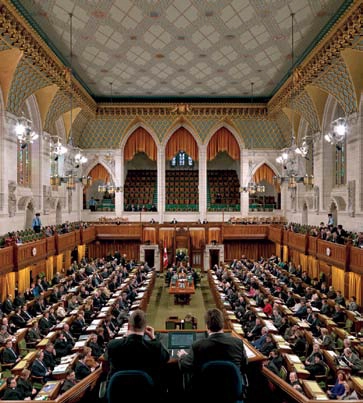
House of Commons chamber: A view of where MPs sit
How it works
Canadians elect MPs to represent them in the House of Commons.
Federal elections must be held every four years on the third Monday in October.
The Prime Minister may request an earlier election.
Canada has 338 electoral districts, each represented by one MP.
Slide 1 of 7
Electing MPs: Canadians elect Members of Parliament (MPs) to represent them in the House of Commons.
Election Timing: Federal elections must be held every four years on the third Monday in October, as required by the Canada Elections Act. The Prime Minister may ask the Governor General to call an earlier election.
Electoral Districts: Canada has 338 electoral districts, also known as ridings or constituencies.
MP Representation: Each electoral district elects one MP who represents them in the House of Commons.
Candidate Eligibility: Any Canadian citizen who is at least 18 years old on election day can run as a candidate in a federal election.
Voting Choice: Voters choose one candidate on the ballot; the candidate with the most votes becomes the MP for that riding.
Voter Eligibility: You are eligible to vote if you are a Canadian citizen, at least 18 years old on voting day, and listed on the voters’ list.
Voters’ List: The voters’ list is maintained by Elections Canada using the National Register of Electors.
Voter Information Card: Elections Canada mails a voter information card to each registered elector with information on when and where to vote, and how to access services if needed.
Voter Registration: You can register to vote at any time, including on election day.
Alternative Voting Options: If you cannot vote on election day, you may vote at advance polls or by special ballot.
Secret Ballot: Voting is confidential. No one can see how you vote, and you are not required to tell anyone how you voted.
Forming Government: The leader of the party with the most seats in the House of Commons is invited by the Governor General to form the government.
Majority vs. Minority: If the party wins more than half of the seats, it forms a majority government; if not, it forms a minority government that needs support from other parties.
Cabinet Appointments: The Prime Minister appoints Cabinet ministers, usually from elected MPs, to run federal government departments.
Cabinet Definition: The Prime Minister and Cabinet ministers together are known as the Cabinet.
Cabinet Role: Cabinet ministers help govern the country, prepare the budget, and propose most new laws.
Opposition Parties: The party with the second most seats becomes the Official Opposition, which helps hold the government accountable.
Confidence of the House: The government must maintain the confidence of the House of Commons to stay in power.
Loss of Confidence: If a major decision like the budget is voted down in the House, it may result in a new election or another party being invited to form the government.
Voter Information Card: Registered voters receive a voter information card confirming their name is on the voters’ list and showing where and when to vote.
Registration Issues: If you don’t receive a card, contact your local elections office or Elections Canada to confirm your registration.
Early Voting Options: Advance polls and special ballots allow you to vote early if you can’t vote on election day.
What to Bring: Bring your voter information card and proper ID showing your name and address to your polling station.
Marking the Ballot: Go behind a screen and mark an 'X' in the circle next to the name of your chosen candidate.
Ballot Box: Ballots are deposited into a sealed ballot box.
Secrecy Guaranteed: No one may force you to reveal your vote. Your choice is protected by law.
Counting Votes: Once the polls close, election officers count the ballots and results are shared on TV, radio, newspapers, and the Elections Canada website.
Municipal Government
Municipal Leadership: Governed by a mayor (or reeve) and councillors.
Municipal Responsibilities: Handles local matters such as roads, sanitation, firefighting, emergency services, recreation facilities, and public transit.
Provincial and Territorial Government
Provincial/Territorial Leadership: Led by a Premier and elected members called MLAs, MNAs, MPPs, or MHAs.
Provincial/Territorial Responsibilities: Responsible for education, health care, highways, natural resources, civil rights, and policing (in Ontario and Quebec).
First Nations Governance
First Nations Leadership: Governed by band chiefs and councillors on reserves.
First Nations Responsibilities: Responsible for housing, education, and local services.
Organizational Support: Supported by provincial, regional, and national Indigenous organizations.
Key points
Key Points to Remember
Voting Rights and Responsibilities: Voting is both a right and a responsibility of Canadian citizenship.
Representation: Federal elections decide who represents Canadians in the House of Commons.
Government Formation: Election outcomes determine whether a majority or minority government is formed.
Secret Ballot: Canadian law guarantees a secret ballot to protect voters' privacy.
Election Law Basis: Fixed election dates were established under the Canada Elections Act to promote regular and predictable election cycles.
Opposition Role: Opposition parties challenge the government’s decisions and propose alternatives.
Variation in Rules: Voting rules for provincial, territorial, and municipal elections may differ from federal ones.
Check Local Rules: Always check with your local election office for the most accurate and current voting procedures.
Municipal Government Role: Municipal governments pass local by-laws and manage community services.
Note: The names of your representatives will vary depending on where you live. This section is for your personal reflection and is not tested on the citizenship exam.
Know Your Leaders: You can find the names of your MP, provincial representative, and local officials at www.elections.ca or your provincial government website.
Gallery
FAQs
Voting Process and Participation
Any Canadian citizen who is at least 18 years old on voting day and is listed on the voters’ list.
It is a card sent by Elections Canada that tells you when, where, and how to vote.
You can contact Elections Canada or your local elections office to confirm your registration, and register at any time, including on election day.
Yes. You can vote at advance polls or by special ballot if you can’t vote on election day.
Bring your voter information card and ID showing your name and address to your assigned polling station.
Yes. Canadian law protects the secrecy of your vote—no one can force you to reveal how you voted.
Mark an ‘X’ in the circle next to your chosen candidate’s name behind a privacy screen.
Your ballot is placed in a sealed ballot box and counted after the polls close.
Election results are published on the Elections Canada website, TV, radio, and newspapers.
Elections Canada maintains it using the National Register of Electors.
Government Structure and Formation
The Governor General invites the leader of the party with the most seats in the House of Commons to form the government.
A majority government holds more than half the seats; a minority holds fewer than half and needs support from other parties to govern.
The Cabinet is made up of ministers selected by the Prime Minister. They manage federal departments, propose laws, and prepare the budget.
A vote in the House of Commons on a major issue like the budget. If the government loses it, an election may be called.
It usually results in a new election or another party being invited to form a government.
They are parties not in power that challenge the government’s actions and propose alternatives.
The political party with the second most seats in the House of Commons.
It is the elected chamber of Canada’s Parliament where Members of Parliament (MPs) represent Canadians and pass laws.
There are 338 electoral districts, also known as ridings or constituencies.
As of July 2025: Liberal Party, Conservative Party, New Democratic Party, Bloc Québécois, and Green Party.
Practice
Feel ready?
Try the full practice test or explore your next lesson to keep building your confidence.
Up next
Rights & Responsibilities
High-yield civic rights, freedoms, and responsibilities that appear often.
🇨🇦 This lesson is inspired by official content from the Discover Canada guide by the Government of Canada.

