Understanding the structure and functioning of Canada's government system.
What's inside

Local voices, shared decisions.
Key points
Key Points to Remember
Canada is a federal state, a parliamentary democracy, and a constitutional monarchy.
The Constitution Act defines responsibilities for different levels of government.
Laws must go through multiple steps, including debate, review, and royal assent.
The Sovereign plays a symbolic role in government and national identity.
The Governor General and Lieutenant Governors act as the Sovereign’s representatives.
Slide-Based Overview
/ 09
keys
A Nation Built on Law, Liberty & Shared Responsibility
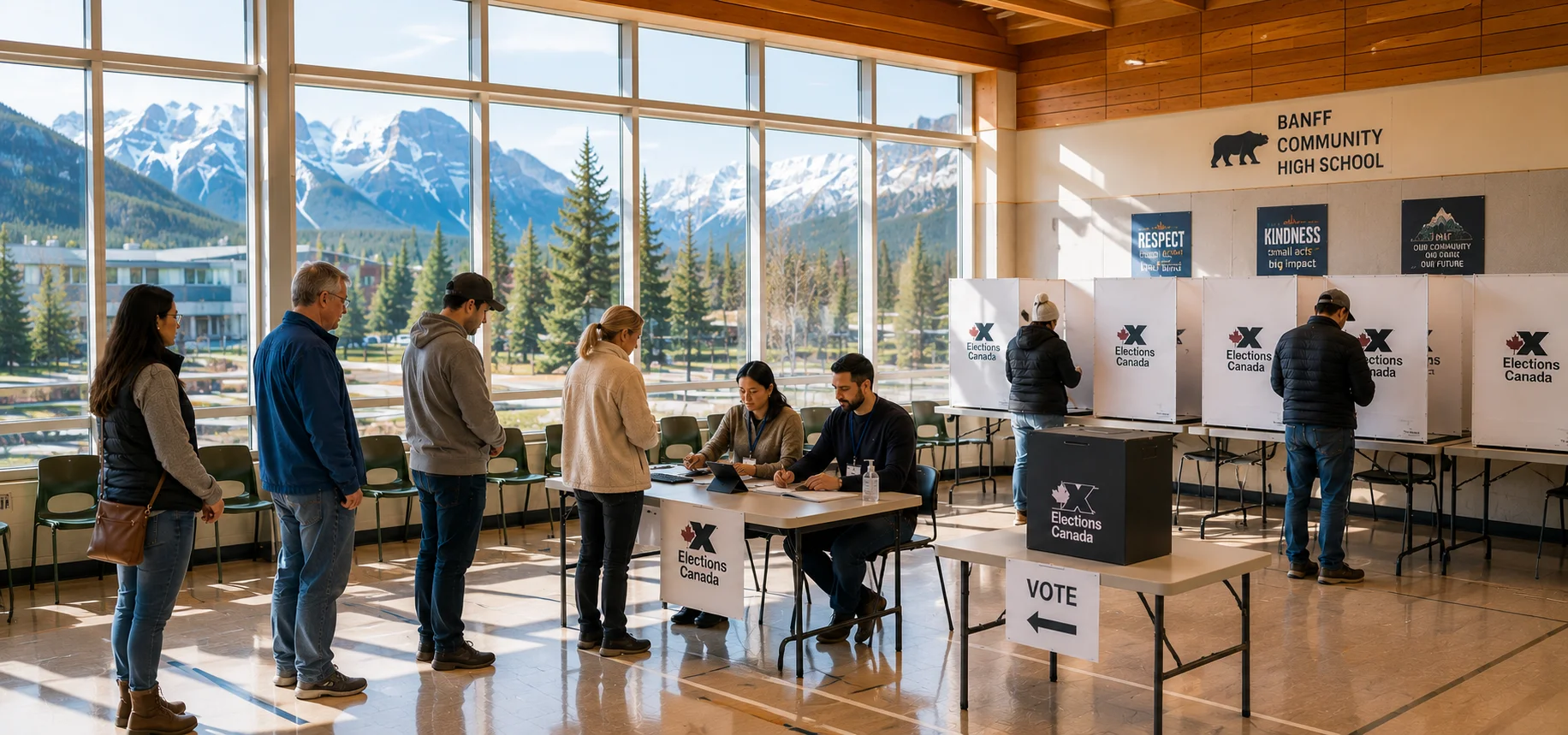
Election day in the Rockies.
Slide 1 of 9
Canada is a federal state, a parliamentary democracy, and a constitutional monarchy.
Canada has federal, provincial, territorial, and municipal levels of government.
The Constitution Act, 1867 (formerly the British North America Act) defines federal and provincial responsibilities.
Federal Responsibilities
National and international matters: defence, foreign policy, interprovincial trade and communications, currency, navigation, criminal law, and citizenship.
Provincial Responsibilities
Municipal government, education, health, natural resources, property and civil rights, and highways.
Some responsibilities are shared with the federal government, such as agriculture and immigration.
Provincial and Territorial Governments
Each province has its own elected Legislative Assembly, similar to the federal House of Commons.
The three northern territories have assemblies with similar functions but do not hold full provincial status.
Canadians elect representatives to the House of Commons and provincial/territorial legislatures.
These representatives pass laws, approve expenditures, and keep the government accountable.
Cabinet ministers must maintain the confidence of the elected legislature to remain in office.
Parliament Structure
The federal Parliament consists of three parts: the Sovereign (King or Queen), the Senate, and the House of Commons.
Each province’s legislature includes the Lieutenant Governor and the elected Assembly.
Federal Government Roles
The Prime Minister leads the federal government and selects Cabinet ministers.
Members of Parliament (MPs) are elected by the people, generally every four years.
Senators are appointed by the Governor General on the Prime Minister’s advice and serve until age 75.
Legislative Process Overview
A bill must be passed by both the House of Commons and the Senate, then receive royal assent to become law.
Canada’s legislative process includes seven stages involving review, debate, amendment, and final approval.
Steps to Pass a Bill
First Reading: Bill is introduced and printed.
Second Reading: Members debate the bill’s principle.
Committee Stage: Committee studies the bill clause by clause.
Report Stage: Additional amendments may be proposed.
Third Reading: Final debate and vote in the House of Commons.
Senate Review: Senate follows a similar review process.
Royal Assent: Governor General gives final approval on behalf of the Sovereign.
Democratic Participation
Canadian citizens aged 18 or older have the right and responsibility to vote in federal, provincial/territorial, and municipal elections.
Canada’s Head of State is a hereditary Sovereign who reigns according to the Constitution.
The Sovereign symbolizes the rule of law, unity, and allegiance.
Canada is a member of the Commonwealth, linking it to 53 other nations.
Role of the Sovereign
Plays a non-partisan role as the ceremonial focus of citizenship and allegiance.
The Royal Family’s dedication to public service encourages citizens to contribute to society.
Governor General and Lieutenant Governor
The Governor General is appointed by the Sovereign on the advice of the Prime Minister, typically for a five-year term.
Each province’s Lieutenant Governor is appointed by the Governor General, also based on the Prime Minister’s advice.
Provincial and Territorial Governments
Provincial Premiers and Territorial Commissioners
Provincial Premiers lead provincial governments, similar to the Prime Minister federally.
Territorial Commissioners represent the federal government ceremonially.
Branches of Government
Canada’s Executive, Legislative, and Judicial branches work both collaboratively and independently to uphold the rights and freedoms of Canadians.
Canada’s government is composed of three branches: Executive, Legislative, and Judicial.
Parliament includes the Sovereign, Senate, and House of Commons.
This structure ensures a balance of power and public accountability.
Parliament
Parliament debates and enacts federal laws.
It includes the Sovereign, the Senate, and the House of Commons.
Executive Branch
Led by the Prime Minister and Cabinet.
Implements laws and manages day-to-day government functions.
The Governor General performs ceremonial duties on behalf of the Sovereign.
Legislative Branch
Responsible for making, changing, or repealing laws.
Includes the Sovereign, the Senate, and the House of Commons.
Judiciary
Interprets laws and ensures they align with the Constitution.
Operates independently from the political branches of government.
Protects rule of law and checks the power of the executive and legislature.
Key points
Key Points to Remember
Canada is a federal state, a parliamentary democracy, and a constitutional monarchy.
The Constitution Act defines responsibilities for different levels of government.
Laws must go through multiple steps, including debate, review, and royal assent.
The Sovereign plays a symbolic role in government and national identity.
The Governor General and Lieutenant Governors act as the Sovereign’s representatives.
Gallery
FAQs
Understanding Canada’s System of Government
Canada is a federal state, a parliamentary democracy, and a constitutional monarchy.
Canada has multiple levels of government—federal, provincial/territorial, and municipal—with powers defined by the Constitution Act, 1867.
The federal government is responsible for national and international affairs such as defence, foreign policy, interprovincial trade, communications, currency, navigation, criminal law, and citizenship.
Provinces manage matters such as education, health care, natural resources, highways, property and civil rights, and municipal governments.
Agriculture and immigration are shared responsibilities.
It is a system where citizens elect representatives to legislative bodies who pass laws, monitor government spending, and hold the government accountable.
Parliament consists of the Sovereign (King or Queen), the Senate, and the House of Commons.
The Prime Minister is usually the leader of the party with the most seats in the House of Commons and appoints Cabinet ministers to manage government portfolios.
Senators review, amend, and vote on bills. They are appointed by the Governor General on the Prime Minister’s advice and serve until age 75.
Royal assent is the final step in the legislative process when the Governor General formally approves a bill on behalf of the Sovereign, making it law.
Constitutional Monarchy and the Law-Making Process
The Sovereign (King or Queen), who is represented in Canada by the Governor General.
The Head of State is the Sovereign, who symbolizes Canadian sovereignty. The Head of Government is the Prime Minister, who leads the federal government and makes executive decisions.
The Governor General represents the Sovereign, grants royal assent to laws, and performs ceremonial and constitutional duties.
The Governor General is appointed by the Sovereign on the Prime Minister’s advice. Lieutenant Governors are appointed by the Governor General, also on the Prime Minister’s advice, for each province.
A bill must go through First Reading, Second Reading, Committee Stage, Report Stage, Third Reading, then repeat similar steps in the Senate before receiving royal assent to become law.
The bill is reviewed in detail, clause by clause, and members of the committee can propose changes or amendments.
Voting gives citizens a voice in choosing their representatives and helps shape the laws and policies that affect their lives.
A Commissioner, who performs ceremonial duties and represents the federal government in the territories.
It includes the Supreme Court of Canada, the Federal Court, and provincial courts. The Supreme Court has nine judges appointed by the Governor General.
They are called Members of the Legislative Assembly (MLAs), Members of the National Assembly (MNAs), Members of Provincial Parliament (MPPs), or Members of the House of Assembly (MHAs), depending on the province or territory.
Practice
Feel ready?
Try the full practice test or explore your next lesson to keep building your confidence.
🇨🇦 This lesson is inspired by official content from the Discover Canada guide by the Government of Canada.

