
Canadian Symbols
The Crown, the flags, the maple leaf and the fleur-de-lys, the coat of arms, the Parliament Buildings, sports, the beaver, the official languages, the anthems, honours and the national holidays, as Discover Canada presents them.
What's inside
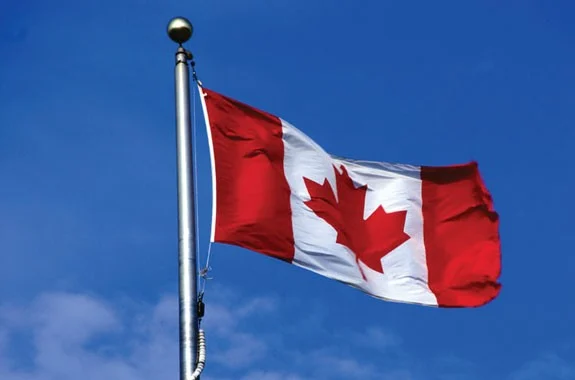
The Canadian flag of 1965: one red maple leaf on white between two red bars.
Slide-Based Overview
/ 10
keys
Eleven parts
Canadian Symbols at a Glance
Slide 1 of 10
Key points
27Key Points to Remember
Read these points, then try the lesson quiz.
Show key pointsHide key points
Key points
27Key Points to Remember
Read these points, then try the lesson quiz.
Show key pointsHide key pointsThe Crown: A symbol of the state for 400 years. Canada has been a constitutional monarchy in its own right since Confederation in 1867.
Queen Elizabeth II in the guide: Queen of Canada since 1952; Golden Jubilee 2002; Diamond Jubilee (60 years) 2012. Today the Sovereign is King Charles III.
The Crown stands for: Government, including Parliament, the legislatures, the courts, police services and the Canadian Forces.
The flag: First raised in 1965. Its red-white-red pattern comes from the flag of the Royal Military College, Kingston (founded 1876).
Red and white: The colours of France and England since the Middle Ages; Canada’s national colours since 1921.
Other flags: The Union Jack is the official Royal Flag. The Canadian Red Ensign was the flag for about 100 years. Provinces and territories have their own flags.
The maple leaf: Canada’s best-known symbol. Adopted by French-Canadians in the 1700s; on uniforms and insignia since the 1850s; carved into the headstones of fallen soldiers.
The fleur-de-lys: The lily flower, adopted by the French king in 496; the symbol of French royalty and New France; revived at Confederation; on Quebec’s flag since 1948, with the Cross.
Coat of arms and motto: Adopted after the First World War. The motto A Mari Usque Ad Mare means “from sea to sea”. The arms show symbols of England, France, Scotland and Ireland, and red maple leaves. The guide says they appear on dollar bills, government documents and public buildings.
Parliament Buildings: In Ottawa; French, English and Aboriginal traditions; Gothic Revival; completed in the 1860s; the Centre Block burned in 1916 and was rebuilt in 1922; the Library is the only original part.
The Peace Tower: Completed in 1927 in memory of the First World War. Its Memorial Chamber holds the Books of Remembrance, with the names of soldiers, sailors and airmen who died serving Canada (today in the West Block, during repairs).
Provincial legislatures: Quebec’s National Assembly is French Second Empire; the others are Baroque, Romanesque and neoclassical, reflecting the Greco-Roman heritage in which democracy originated.
Hockey: The most popular spectator sport and the national winter sport; developed in Canada in the 1800s. The NHL plays for the Stanley Cup, donated by Lord Stanley, the Governor General, in 1892.
The Clarkson Cup: Established in 2005 by Adrienne Clarkson, the 26th Governor General and the first of Asian origin; awarded for women’s hockey.
Other sports: Canadian football is second most popular. Curling came with Scottish pioneers. Lacrosse, first played by Aboriginals, is the official summer sport. Soccer has the most registered players.
The beaver: A symbol of the Hudson’s Bay Company; an emblem of the St. Jean Baptiste Society (a French-Canadian patriotic association) in 1834; on the five-cent coin and the coats of arms of Saskatchewan, Alberta, Montreal and Toronto.
Official languages: English and French. Anglophones and Francophones have lived together for more than 300 years. You need adequate English or French to become a citizen; the guide says applicants 55 and over are exempted (today, 18 to 54 must meet it).
The Official Languages Act (1969): Equality of French and English in Parliament, the Government of Canada and institutions subject to the Act; maintain and develop official language minority communities; promote equality of French and English in Canadian society.
O Canada: Proclaimed the National Anthem in 1980; first sung in Québec City in 1880; French and English Canadians sing different words. The guide’s line “in all thy sons command” is “in all of us command” since 2018.
The Royal Anthem: “God Save the King (or Queen)”, played or sung to honour the Sovereign. In French, « Dieu protège le Roi ».
Honours: Orders, decorations and medals. The Order of Canada began in 1967, the centennial of Confederation. You can nominate fellow citizens.
The Victoria Cross: The highest honour available to Canadians, for conspicuous bravery, valour, self-sacrifice or extreme devotion to duty in the presence of the enemy. Awarded to 96 Canadians since 1854, the guide says.
Three recipients: Alexander Roberts Dunn (Balaclava, 1854, the first Canadian); William Hall (the Siege of Lucknow, 1857, the first Black man); Filip Konowal (Hill 70, 1917, born in Ukraine).
Three more: Billy Bishop (a flying ace, First World War, later honorary Air Marshal); Paul Triquet (Casa Berardi, Italy, 1943); Robert Hampton Gray (a Japanese warship, August 1945, the last to date).
Dates, January to June: New Year’s Day (January 1), Sir John A. Macdonald Day (January 11), Good Friday (the Friday before Easter Sunday), Easter Monday, Vimy Day (April 9), Victoria Day (the Monday before May 25), Fête Nationale (June 24).
Dates, July to December: Canada Day (July 1), Labour Day (first Monday of September), Thanksgiving Day (second Monday of October), Remembrance Day (November 11), Sir Wilfrid Laurier Day (November 20), Christmas Day (December 25), Boxing Day (December 26).
The photos: The Red Ensign has been carried officially by veterans since 2005. Oscar Peterson received the Order of Canada from Roland Michener, the 20th Governor General, in 1973; Vincent Massey was the 18th.
Read
What a symbol is: A symbol is an object, an event or a person that has a special meaning. The guide says Canada has many important symbols.
Why they matter: The guide says that, together, these symbols help explain what it means to be Canadian. They express our national identity (who we are as a country).
In this lesson: The Crown, the flags, the maple leaf and the fleur-de-lys, the coat of arms, the Parliament Buildings, sports, the beaver, the official languages, the anthems, honours, and the national holidays.
The photos: The chapter has 16 photos. Their captions (the words under a photo) are the guide’s own words, and some carry test content. Each part below says what its photos show.
How to study this chapter
Names, dates and numbers: This chapter has more dates and numbers than most. The flip cards on slide 2 hold ten that the quiz asks.
The guide and today: The guide was written in 2012. Where things have changed, each part has a box called “What the guide says, and what is true today”. Learn the guide’s words for the test, and know what is true today.
Other lessons: Several symbols appear in other lessons too. This lesson teaches what this chapter says and points to the other lesson in one line where it says more.
A symbol for 400 years: The guide says the Crown has been a symbol of the state in Canada for 400 years. The state means the country and its government.
A constitutional monarchy: Canada has been a constitutional monarchy in its own right since Confederation in 1867, during Queen Victoria’s reign. A reign is the period when a king or queen rules. In a constitutional monarchy, the Sovereign (the King or Queen) is head of state, and elected representatives govern under the Constitution.
Queen Elizabeth II in the guide: The guide says Queen Elizabeth II has been Queen of Canada since 1952. She marked her Golden Jubilee (50 years as Sovereign) in 2002 and her Diamond Jubilee (60 years as Sovereign) in 2012. A jubilee is a celebration of a special anniversary.
A symbol of government: The Crown is a symbol of government, including Parliament, the legislatures (the provincial and territorial assemblies), the courts, police services and the Canadian Forces (the military).
The photo
The Mace: The chapter opens with a photo of the Mace of the House of Commons, Ottawa. A mace is a heavy ceremonial staff. The guide does not say what it stands for.
What the guide says, and what is true today
The Sovereign today: Queen Elizabeth II died on September 8, 2022, after 70 years as Queen of Canada; earlier in 2022 she marked her Platinum Jubilee (70 years). Her son became King Charles III that day and was proclaimed King of Canada at Rideau Hall on September 10, 2022 (Canadian Heritage).
For the test: The guide’s sentences about the Queen, 1952 and the Diamond Jubilee in 2012 are what the guide says. Learn them that way.
Other lessons: The How Canadians Govern Themselves lesson explains the Crown, the Sovereign and the Governor General, who represents the Sovereign in Canada.
A new flag in 1965: A new Canadian flag was raised for the first time in 1965. It is red and white, with one red maple leaf in the centre.
Where the pattern comes from: The red-white-red pattern comes from the flag of the Royal Military College (RMC), a college for military officers, in Kingston, Ontario, founded in 1876.
Red and white: Red and white had been the colours of France and England since the Middle Ages (about the years 500 to 1500). They have been the national colours of Canada since 1921.
The Union Jack: The Union Jack, the flag of the United Kingdom, is Canada’s official Royal Flag.
The Canadian Red Ensign: The Canadian Red Ensign served as the Canadian flag for about 100 years, before 1965. An ensign is a flag; this one was red, with the Union Jack in the corner.
Provincial and territorial flags: The provinces and territories also have their own flags. The guide says they embody (express) their distinct traditions.
The Maple Leaf
Canada’s best-known symbol: The guide says the maple leaf is Canada’s best-known symbol.
A long history: Maple leaves were adopted as a symbol by French-Canadians in the 1700s. They have appeared on Canadian uniforms and insignia (badges) since the 1850s.
On headstones: Maple leaves are carved into the headstones (stones that mark graves) of Canada’s fallen soldiers buried overseas and in Canada.
The Fleur-de-lys
The lily flower: The fleur-de-lys is the lily flower. The guide says it is said that the French king adopted it in the year 496.
French royalty: It became the symbol of French royalty (kings and queens) for more than a thousand years, including in the colony of New France.
Revived at Confederation: It was revived (brought back) at Confederation and included in the Canadian Red Ensign.
Quebec’s flag: In 1948, Quebec adopted its own flag, based on the Cross and the fleur-de-lys. The Who We Are lesson says more about Quebec.
The photos
The Red Ensign: The guide’s caption says the Canadian Red Ensign “served as the national flag for 100 years, and has been carried officially by veterans since 2005”. Veterans are people who served in the military.
The 1965 flag: The second photo is the Canadian Flag of 1965, the maple leaf flag.
What the guide says, and what is true today
The flag’s birthday: The Queen proclaimed (officially declared) the new flag on January 28, 1965, and it was first raised on Parliament Hill on February 15, 1965. Since 1996, February 15 has been National Flag of Canada Day (Canadian Heritage).
The national colours: The guide says red and white have been Canada’s national colours since 1921. Canadian Heritage says the 1921 proclamation of the coat of arms did not declare any national colours, and that this is a popular misconception; red and white have come to represent Canada through common use (Canadian Heritage). The guide’s 1921 is the test wording.
For the test: The guide’s numbers are what the test asks: 1965, 1876, 1921, 100 years, the 1700s, the 1850s, 496, 1948.
After the First World War: The guide says that, as an expression of national pride after the First World War, Canada adopted an official coat of arms and a national motto. A coat of arms is a design that represents a country or a family. A motto is a short saying.
The motto: A Mari Usque Ad Mare. This Latin motto means “from sea to sea”.
What the arms show: The arms contain symbols of England, France, Scotland and Ireland, as well as red maple leaves.
Where the arms appear: The guide says that today the arms can be seen on dollar bills, government documents and public buildings.
The photos
The Royal Arms of Canada: The guide shows the Royal Arms of Canada, the official coat of arms, with the crown, the shield and the motto.
The Snowbirds: The other photo shows the Snowbirds, the Canadian Forces air demonstration team (431 Air Demonstration Squadron). The guide’s caption calls them “a Canadian icon”. An icon is a famous symbol.
What the guide says, and what is true today
The date: The coat of arms was proclaimed by King George V on November 21, 1921, three years after the First World War ended (Governor General of Canada). The guide says “after the First World War”, which is the test wording.
The motto’s source: The words come from the Bible, Psalm 72: “He shall have dominion from sea to sea” (Governor General of Canada).
Where the arms appear today: The Governor General’s office says the arms can be seen on federal buildings and in courtrooms, and on passports, money, seals, proclamations and publications (Governor General of Canada, news release, November 2021). The bank notes in use today have changed since the guide was written. The guide’s list is the test wording.
Three traditions: The guide says the towers, arches, sculptures and stained glass of the Parliament Buildings embody (express) the French, English and Aboriginal traditions. Aboriginal is the guide’s word for First Nations, Inuit and Métis peoples; today people say Indigenous.
Gothic Revival: The buildings are in the Gothic Revival style, which was popular in the time of Queen Victoria. Gothic Revival copies the pointed arches and towers of medieval churches.
Completed in the 1860s: The buildings were completed in the 1860s, around the time of Confederation.
The fire of 1916: The Centre Block was destroyed by an accidental fire in 1916 and rebuilt in 1922. The Library is the only part of the original building that remains.
The Peace Tower: The Peace Tower was completed in 1927 in memory of the First World War.
The Books of Remembrance: The Memorial Chamber within the Tower contains the Books of Remembrance. In them are written the names of soldiers, sailors and airmen who died serving Canada in wars or while on duty.
The provincial legislatures
Architectural treasures: The guide says the provincial legislatures (the buildings where each provincial assembly meets) are architectural treasures.
Their styles: The Quebec National Assembly is built in the French Second Empire style. The legislatures of the other provinces are Baroque, Romanesque and neoclassical. These are styles of grand buildings from different periods of European history.
Greco-Roman heritage: The guide says these styles reflect the Greco-Roman heritage (the traditions of ancient Greece and Rome) of Western civilization, in which democracy originated (began).
The photo
Parliament at dusk: The photo shows the Parliament Buildings in Ottawa at dusk (the time just after sunset), with the Peace Tower in the centre.
What the guide says, and what is true today
The Centre Block today: The Centre Block closed in 2019 for a long rehabilitation (major repairs). While the work goes on, the House of Commons sits in the West Block and the Senate in the Senate of Canada Building (Public Services and Procurement Canada).
The Books of Remembrance today: There are eight Books of Remembrance, with the names of more than 120,000 Canadians. In February 2019 they were moved from the Memorial Chamber to the Room of Remembrance in the West Block, where people can view them during the Centre Block work (Veterans Affairs Canada).
Other lessons: The How Canadians Govern Themselves lesson explains Parliament, the House of Commons and the Senate.
Hockey: The guide says hockey is Canada’s most popular spectator sport (a sport people watch) and is considered to be the national winter sport. Ice hockey was developed in Canada in the 1800s.
The Stanley Cup: The National Hockey League (NHL) plays for the championship Stanley Cup. Lord Stanley, the Governor General, donated (gave) it in 1892.
The Clarkson Cup: The Clarkson Cup, established in 2005 by Adrienne Clarkson, the 26th Governor General (and the first of Asian origin), is awarded for women’s hockey.
Hockey in daily life: Many young Canadians play hockey at school, in a hockey league or on quiet streets (road hockey or street hockey). Parents take them to the hockey rink (an ice surface for skating). Canadian children have collected hockey cards for generations.
Canadian football: Canadian football is the second most popular sport.
Curling: Curling, an ice game introduced by Scottish pioneers (early settlers), is popular.
Lacrosse: Lacrosse, an ancient sport first played by Aboriginals (the guide’s word; today, Indigenous peoples), is the official summer sport.
Soccer: Soccer has the most registered players of any game in Canada. Registered players are people signed up to play in a league.
The photo
The Canadiens: The guide shows the Montreal Canadiens, Stanley Cup Champions, 1978, a team photo on the ice with the Cup.
What the guide says, and what is true today
The national sports by law: The National Sports of Canada Act (1994) declares ice hockey the national winter sport and lacrosse the national summer sport (Justice Laws).
Women’s hockey today: Since 2024, the Professional Women’s Hockey League (PWHL) has played for the Walter Cup (PWHL). The guide’s sentence about the Clarkson Cup is the test wording.
The Stanley Cup’s year: Lord Stanley announced his cup in a letter in March 1892, and the first champions were crowned in 1893 (Hockey Hall of Fame). Some official pages give 1893 as the year of the gift (Governor General of Canada; Canadian Heritage). The guide’s 1892 is the test wording.
Other lessons: The Modern Canada lesson names famous Canadian athletes, including hockey players.
The Hudson’s Bay Company: The beaver was adopted centuries ago as a symbol of the Hudson’s Bay Company, the fur-trading company. The Canada’s History lesson tells its story.
The St. Jean Baptiste Society: The beaver became an emblem (a symbol) of the St. Jean Baptiste Society, a French-Canadian patriotic association, in 1834. Patriotic means loving one’s country. Other groups adopted the beaver too.
Where you see it: The guide calls the beaver an industrious (hard-working) rodent (an animal like a large squirrel, with strong front teeth). It can be seen on the five-cent coin, on the coats of arms of Saskatchewan and Alberta, and on those of cities such as Montreal and Toronto.
The photos
The RCMP Musical Ride: One photo shows the RCMP Musical Ride in Ottawa, Ontario: officers of the Royal Canadian Mounted Police riding black horses in red uniforms. The guide places it with the beaver as a well-known Canadian image.
The industrious beaver: The other photo shows a beaver, with the guide’s caption “The industrious beaver”.
What the guide says, and what is true today
An official symbol: The beaver became an official symbol of Canada on March 24, 1975, when the National Symbol of Canada Act received royal assent (Canadian Heritage).
Two official languages: English and French are the two official languages of Canada. The guide says they are important symbols of identity.
Anglophones and Francophones: English speakers (Anglophones) and French speakers (Francophones) have lived together in partnership and creative tension for more than 300 years. Creative tension means disagreement that leads to good results.
To become a citizen: You must have adequate (good enough) knowledge of English or French to become a Canadian citizen. The guide says adult applicants 55 years of age and over are exempted from (do not need to meet) this requirement.
The Official Languages Act: Parliament passed the Official Languages Act in 1969. The guide says it has three main objectives (aims).
The three objectives, in the guide’s words
Objective 1: “Establish equality between French and English in Parliament, the Government of Canada and institutions subject to the Act”.
Objective 2: “Maintain and develop official language minority communities in Canada”. These are English-speaking communities in Quebec and French-speaking communities outside Quebec.
Objective 3: “Promote equality of French and English in Canadian society”.
What the guide says, and what is true today
The language requirement today: Since October 11, 2017, applicants aged 18 to 54 must show adequate knowledge of English or French. Applicants 55 and over do not (Immigration, Refugees and Citizenship Canada, IRCC). The guide’s “55 years of age and over” is the test wording.
The Act today: Parliament modernized the Official Languages Act in 2023, with An Act for the Substantive Equality of Canada’s Official Languages (royal assent, the final approval that makes a bill law, on June 20, 2023). The three objectives in the guide are from the 1969 Act; today’s Act still has them among its purposes (Justice Laws).
Other lessons: The Applying for Citizenship lesson explains the language requirement. The Who We Are lesson explains Anglophones, Francophones and Quebec. The Modern Canada lesson mentions the Act too.
O Canada: O Canada was proclaimed (officially declared) the National Anthem in 1980. An anthem is a nation’s official song.
First sung in 1880: It was first sung in Québec City in 1880, a hundred years before it became the official anthem.
Two sets of words: French and English Canadians sing different words to the National Anthem. The French words are not a translation of the English words.
The texts: The two official texts below are the guide’s. Each line is separated by a slash (/). Learn the English words the guide prints; the test may ask about a line.
O Canada, the English words
O Canada! Our home and native land! / True patriot love in all thy sons command
With glowing hearts we see thee rise / The true North strong and free!
From far and wide, O Canada we stand on guard for thee / God keep our land glorious and free!
O Canada, we stand on guard for thee / O Canada, we stand on guard for thee
Ô Canada, the French words
O Canada! Terre de nos aïeux, / Ton front est ceint de fleurons glorieux!
Car ton bras sait porter l’épée, / Il sait porter la croix!
Ton histoire est une épopée / Des plus brillants exploits.
Et ta valeur, de foi trempée, / Protégera nos foyers et nos droits.
Protégera nos foyers et nos droits.
Royal Anthem
God Save the King: The Royal Anthem of Canada is “God Save the King (or Queen)”. The guide says it can be played or sung on any occasion when Canadians wish to honour the Sovereign.
The title changes with the Sovereign: When a king reigns, it is “God Save the King”; when a queen reigns, “God Save the Queen”. The French title is « Dieu protège le Roi ».
God Save the King, the English words
God save our gracious King / Long live our noble King,
God save The King: / Send him victorious,
Happy and glorious, / Long to reign over us:
God save The King.
Dieu protège le Roi, the French words
Dieu protège le Roi / De sa main souveraine!
Vive le Roi! / Qu’un règne glorieux,
Long et victorieux / Rende son peuple heureux.
Vive le Roi!
What the guide says, and what is true today
O Canada’s English words today: In 2018, Parliament changed one line of the English words. “True patriot love in all thy sons command” became “True patriot love in all of us command” (An Act to amend the National Anthem Act, royal assent February 7, 2018; Canadian Heritage). The guide prints the old line, and that is the test wording.
The dates in full: O Canada was first performed on June 24, 1880, in Québec City, and proclaimed the National Anthem on July 1, 1980, under the National Anthem Act (Canadian Heritage).
The Royal Anthem today: Since 2022 the Sovereign is King Charles III, so the Royal Anthem is “God Save the King”, as the guide prints it. Canadian Heritage says it is played at official events in the presence of the Sovereign or the Sovereign’s representatives, and is no longer customary at other public events (Canadian Heritage).
What this means: Sing “all of us command” today. For the test, know that the guide says “all thy sons command”.
Honours: All countries have ways to recognize outstanding citizens. The guide says official awards are called honours, and they consist of orders, decorations and medals. A decoration is an award for a brave or special act; a medal is a metal disc given for service or achievement.
The Order of Canada: After using British honours for many years, Canada started its own honours system with the Order of Canada in 1967, the centennial (100th anniversary) of Confederation.
Nominating someone: The guide says that if you know fellow citizens who you think are worthy of recognition, you are welcome to nominate them (put their names forward). It gives a web address for information on nominations.
The Victoria Cross
The highest honour: The Victoria Cross (V.C.) is the highest honour available to Canadians.
What it is awarded for, in the guide’s words: “the most conspicuous bravery, a daring or pre-eminent act of valour or self-sacrifice, or extreme devotion to duty in the presence of the enemy”. Conspicuous means very noticeable. Valour means great courage in battle. Pre-eminent means outstanding.
How many: The guide says the V.C. has been awarded to 96 Canadians since 1854. The guide names six of them.
Alexander Roberts Dunn: Then Lieutenant Dunn, born in present-day Toronto, served in the British Army in the Charge of the Light Brigade at Balaclava (1854) in the Crimean War. He was the first Canadian to be awarded the Victoria Cross.
William Hall: Able Seaman William Hall of Horton, Nova Scotia, whose parents were American slaves, was the first Black man to be awarded the V.C., for his role in the Siege of Lucknow during the Indian Rebellion of 1857.
Filip Konowal: Corporal Filip Konowal, born in Ukraine, showed exceptional courage in the Battle of Hill 70 in 1917. He became the first member of the Canadian Corps not born in the British Empire to be awarded the V.C.
Billy Bishop: Flying ace Captain Billy Bishop, born in Owen Sound, Ontario, earned the V.C. in the Royal Flying Corps during the First World War. A flying ace is a pilot who has shot down many enemy aircraft. He was later an honorary Air Marshal of the Royal Canadian Air Force.
Paul Triquet: Captain Paul Triquet of Cabano, Quebec, earned the V.C. leading his men and a handful of tanks in the attack on Casa Berardi in Italy in 1943, during the Second World War. He was later a Brigadier (a senior army officer).
Robert Hampton Gray: Lieutenant Robert Hampton Gray, a navy pilot born in Trail, B.C. (British Columbia), was killed while bombing and sinking a Japanese warship in August 1945, a few days before the end of the Second World War. He was the last Canadian to receive the V.C. to date (so far).
The photos
Oscar Peterson: The guide’s caption says jazz pianist Oscar Peterson (left) receives the Order of Canada from Roland Michener (right), the 20th Governor General, in 1973. In the centre are Norah Michener and a portrait of Vincent Massey, the 18th Governor General.
The six recipients: The chapter shows portraits of the six Victoria Cross recipients: Colonel Alexander Roberts Dunn, Able Seaman William Hall, Brigadier Paul Triquet, Filip Konowal (who was promoted Sergeant), Air Marshal William A. Bishop (Billy Bishop) and Lieutenant Robert Hampton Gray.
What the guide says, and what is true today
Nominations today: The guide’s web address no longer works. Anyone can nominate a person for the Order of Canada and other honours with the online tool on the Governor General’s website, gg.ca (Governor General of Canada).
The Victoria Cross count today: Veterans Affairs Canada says 99 Canadians have been awarded the Victoria Cross (Canadian-born, serving in the Canadian Army, or with a close link to Canada). Other counts differ, depending on who is counted. The guide’s 96 is the test number (Veterans Affairs Canada).
The Canadian Victoria Cross: In 1993, Canada created its own Victoria Cross. It looks almost the same, but its words are in Latin, Pro Valore (for valour). No one has been awarded it yet (Veterans Affairs Canada; National Defence).
Other lessons: The Canada’s History lesson tells the story of the wars in which these six served, including Vimy Ridge in the First World War.
The guide’s list: The guide lists 14 national public holidays and other important dates, in calendar order. Learn each date with its name. Preceding means before; following means after.
New Year’s Day: January 1
Sir John A. Macdonald Day: January 11
Good Friday: Friday immediately preceding Easter Sunday
Easter Monday: Monday immediately following Easter Sunday
Vimy Day: April 9
Victoria Day: Monday preceding May 25 (Sovereign’s Birthday)
Fête Nationale (Quebec): June 24 (Feast of St. John the Baptist)
Canada Day: July 1
Labour Day: First Monday of September
Thanksgiving Day: Second Monday of October
Remembrance Day: November 11
Sir Wilfrid Laurier Day: November 20
Christmas Day: December 25
Boxing Day: December 26
What the guide says, and what is true today
Holidays and other dates: The guide’s list mixes statutory holidays (days off by law, such as Canada Day and Labour Day) with days of recognition, when people work as usual: Sir John A. Macdonald Day and Sir Wilfrid Laurier Day (an Act of 2002) and Vimy Ridge Day (an Act of 2003, which says it is not a legal holiday, that is, not a statutory holiday). The guide does not say which is which, and the test follows the guide (Justice Laws).
A new day since the guide: September 30 is the National Day for Truth and Reconciliation, a federal statutory holiday since 2021. The Who We Are lesson explains it (Canadian Heritage).
The Sovereign’s birthday: A proclamation of May 2023 fixed Victoria Day, the Monday before May 25, as the day Canada celebrates the Sovereign’s birthday, whoever the Sovereign is (Canadian Heritage).
Other lessons: The Canada’s History lesson explains Vimy Day and Remembrance Day, and the Who We Are lesson explains the Fête Nationale.
Gallery
Canadian Symbols
Jump to part
The Canadian Crown
Flags in Canada
Coat of Arms and Motto
Parliament Buildings
Popular Sports
The Beaver
The Order of Canada and Other Honours
FAQs
Frequently Asked Questions
Studying this chapter
Both. The guide says Queen Elizabeth II, Queen of Canada since 1952. Today the Sovereign is King Charles III. Learn the guide’s sentence for the test, and know today’s name (Part 2).
The words the guide prints, with “in all thy sons command”. Since 2018, the official line is “in all of us command” (Part 9).
Yes. The quiz asks about each one: a name, a place and a war. Slide 8 has one line for each (Part 10).
Yes. The quiz asks most of them. Slide 9 lists them in two halves of the year (Part 11).
Common mix-ups
No. The maple leaf was a symbol in the 1700s, but the maple leaf flag was first raised in 1965. Before that, the Canadian Red Ensign served for about 100 years (Part 3).
No. The Victoria Cross is the highest honour available to Canadians. The Order of Canada, begun in 1967, is Canada’s own honours system (Part 10).
Both, in different seasons. Hockey is the national winter sport and lacrosse is the official summer sport (Part 6).
The guide says applicants 55 years of age and over. Today, applicants aged 18 to 54 must meet the requirement, so those under 18 and 55 and over do not (Part 8).
Related lessons
Practice
Test what you've learned
Answer questions on this lesson without looking back. Recalling on your own helps you remember.
about 3 min for 5 questions
Up next
Canada’s EconomyWhy the guide calls Canada a trading nation, the three main types of industries, and trade with the United States.
🇨🇦 This lesson is inspired by official content from the Discover Canada guide by the Government of Canada.