
Who We Are
Canada's identity and its three founding peoples: Aboriginal, French and British. Also: unity in diversity, English and French, becoming Canadian, and the many groups that make up Canada today.
What's inside
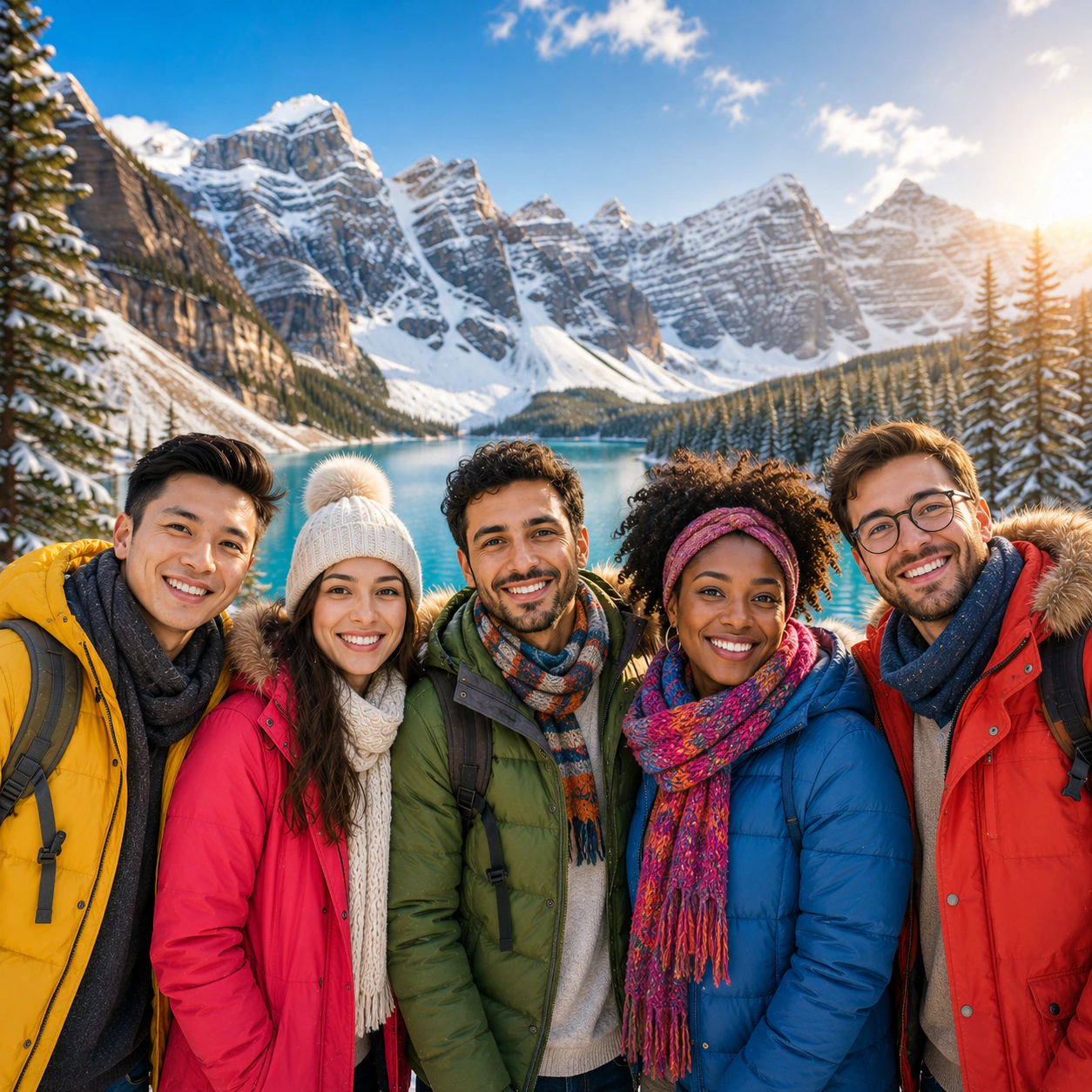
Friends from many backgrounds by a mountain lake.
Slide-Based Overview
/ 10
keys
Seven parts of this lesson
Who We Are at a Glance
Slide 1 of 10
Key points
28Key Points to Remember
Read these points, then try the lesson quiz.
Show key pointsHide key points
Key points
28Key Points to Remember
Read these points, then try the lesson quiz.
Show key pointsHide key pointsCanada's identity: The guide says Canada is a strong and free country with the oldest continuous constitutional tradition in the world.
Constitutional monarchy: Canada is a constitutional monarchy. The guide says it is the only one in North America.
Peace, Order, and Good Government: A key phrase in the British North America Act of 1867, Canada's original constitutional document.
Four values: Ordered liberty, enterprise, hard work and fair play helped Canadians build a prosperous society.
The Great Dominion: What poets and songwriters have called Canada.
Three founding peoples: Aboriginal, French and British.
Aboriginal peoples: Their ancestors are believed to have come from Asia. First Nations cultures were rooted in beliefs about the Creator, nature and each other. Aboriginal and treaty rights are in the Constitution.
Royal Proclamation of 1763: Issued by King George III. It first guaranteed territorial rights and set the basis for treaties, which were not always fully respected.
Residential schools: The federal government placed many Aboriginal children in them to assimilate them. The schools were poorly funded, students suffered hardship, and their languages were mostly prohibited. Ottawa formally apologized in 2008.
Aboriginal peoples today: Renewed pride and confidence, and significant achievements in agriculture, the environment, business and the arts.
Three groups in the guide: First Nations 65%, Métis 30%, Inuit 4%.
First Nations: The term used since the 1970s. In the guide, about half live on reserve land in about 600 communities; the other half live mainly in cities.
Inuit: “The people” in Inuktitut. They live across the Arctic, and their knowledge of the land, sea and wildlife helped them adapt.
Métis: Mixed Aboriginal and European ancestry. Most live in the Prairie provinces, the guide says, and they speak Michif.
John Buchan: Governor General from 1935 to 1940. Immigrant groups keep their individuality, learn from each other, and share a new loyalty to Canada.
Roots and languages: Canadian society stems largely from the English- and French-speaking Christian civilizations. English and French are the official languages, and the federal government must provide services in both.
New Brunswick: The only officially bilingual province.
Anglophones and Francophones: 18 million and 7 million in the guide. Most Francophones live in Quebec; one million live in Ontario, New Brunswick and Manitoba.
Acadians: Settled from 1604. More than two-thirds were deported between 1755 and 1763, the “Great Upheaval.” They survived and kept their identity, and their culture is flourishing today.
Quebecers: Most are descendants of 8,500 French settlers. In 2006 the House of Commons recognized that the Québécois form a nation within a united Canada. One million Anglo-Quebecers have a 250-year heritage.
English Canadians: English, Welsh, Scottish and Irish settlers set up the way of life in English-speaking areas, from the 1600s to the 20th century. That is why Anglophones are generally called English Canadians.
Becoming Canadian: Past conflict does not justify bringing violent, extreme or hateful prejudices. Newcomers are expected to embrace democratic principles such as the rule of law.
Born here: Most Canadians were born in Canada. This has been true since the 1800s. Canada is a land of immigrants: newcomers helped build and defend it over 200 years.
Largest groups: English, French, Scottish, Irish, German, Italian, Chinese, Aboriginal, Ukrainian, Dutch, South Asian and Scandinavian. Since the 1970s, most immigrants have come from Asia.
Languages at home: Chinese languages are second, after English, in Vancouver (13% in the guide) and Toronto (7%).
Faith: Catholic is the largest religious group. The state has partnered with faith communities, for example to provide schools and resettle refugees.
Equality: Gay and lesbian Canadians have full protection and equal treatment under the law, including civil marriage.
Black Loyalists: In the 1780s, Black Loyalists, escaped slaves and freed men and women of African origin fled to Canada from the United States. The guide's caption on Olympian Marjorie Turner-Bailey of Nova Scotia, a descendant, is the one photo caption the test may ask about.
Read
Strong and free: Canada is known around the world as a strong and free country. Canadians are proud of their unique (one of a kind) identity.
The oldest constitutional tradition: The guide says Canada has inherited the oldest continuous constitutional tradition in the world. To inherit means to receive from the past. Continuous means it has never been broken. A constitution is the set of basic rules for how a country is governed.
Constitutional monarchy: Canada is a constitutional monarchy. In a constitutional monarchy, a king or queen is the head of state (the country's highest representative), and a constitution sets the rules. The guide says Canada is the only one in North America. The How Canadians Govern Themselves lesson explains how it works.
Peace, Order, and Good Government: Canada's institutions are its main bodies, such as Parliament and the courts. They uphold (support and protect) a commitment to Peace, Order, and Good Government. This is a key phrase in the British North America Act of 1867. That law was Canada's original constitutional document, its first set of basic rules.
Four values that built Canada: The guide names ordered liberty, enterprise, hard work and fair play. A belief in them helped Canadians build a prosperous (successful and wealthy) society. Ordered liberty is freedom protected by law. Enterprise means starting and building businesses. Fair play means treating others fairly.
From ocean to ocean: Canadians built this society in a rugged (rough and wild) land. It reaches from the Atlantic to the Pacific Ocean and north to the Arctic Circle.
The Great Dominion: Poets and songwriters have hailed (praised) Canada as the “Great Dominion.” Dominion is an old title for Canada. The Canada's History lesson explains it.
Three founding peoples
Aboriginal, French and British: Canada has three founding peoples: Aboriginal, French and British. To understand what it means to be Canadian, it is important to know about them. They are the peoples who formed the country. Parts 2 and 4 explain each one.
What the guide says, and what is true today
The only one in North America: The guide says no other country in North America is a constitutional monarchy. Other countries in North America, such as Belize and the Bahamas, also have the King as head of state, each with its own Governor General (the Royal Household, royal.uk). Learn the guide's statement for the test.
The Sovereign today: Canada's head of state is His Majesty King Charles III (Government of Canada, The Crown in Canada). The guide was written in 2012, when Queen Elizabeth II was Queen.
Words to know: The guide uses the term Aboriginal peoples. Today people usually say Indigenous peoples. Both mean First Nations, Inuit and Métis (Government of Canada).
The first peoples: The ancestors (family members who lived long ago) of Aboriginal peoples are believed to have migrated (moved) from Asia. This was many thousands of years ago. They were well established here long before explorers from Europe first came to North America.
Cultures: First Nations cultures were diverse (very different from each other) and vibrant (full of life). They were rooted in religious beliefs about their relationship to the Creator, the natural environment and each other.
Rights in the Constitution: Aboriginal and treaty rights are in the Canadian Constitution. A treaty is a formal agreement, for example between the Crown (the King, acting through the government) and a First Nation.
The Royal Proclamation of 1763: King George III issued (officially announced) the Royal Proclamation of 1763. It first guaranteed territorial rights, which are rights to land. It also set the basis for negotiating (discussing to reach) treaties with the newcomers. These treaties were not always fully respected.
In today's Canada, the guide says: Aboriginal peoples enjoy renewed pride and confidence. They have made significant (important) achievements in agriculture, the environment, business and the arts.
Residential schools
What they were: From the 1800s until the 1980s, the federal government placed many Aboriginal children in residential schools. Children lived at these schools, away from their families.
Their purpose: The schools were meant to educate the children and assimilate them into mainstream (majority) Canadian culture. To assimilate means to make a group give up its own culture and take on the culture of the majority.
Hardship: The schools were poorly funded and inflicted (caused) hardship on the students. Some were physically abused. Hardship means great difficulty and suffering. Aboriginal languages and cultural practices were mostly prohibited (not allowed).
The apology: In 2008, Ottawa (the federal government) formally apologized to the former students. Prime Minister Stephen Harper made the apology in the House of Commons (Government of Canada).
Truth and Reconciliation: The Truth and Reconciliation Commission (2008 to 2015) heard from thousands of former students. A commission is an official group set up to study something. It found that many children were abused, and that thousands died at the schools. Its final report (2015) made 94 Calls to Action (recommendations) and called the schools a policy of cultural genocide, the destruction of a people's culture (Truth and Reconciliation Commission). Reconciliation means rebuilding good relations. Since 2021, September 30 has been the National Day for Truth and Reconciliation (Government of Canada).
Three distinct groups
First Nations: The guide says the term Indian refers to all Aboriginal people who are not Inuit or Métis. In the 1970s, the term First Nations began to be used. Today most people say First Nations; the word Indian is still used in some laws, such as the Indian Act.
Where First Nations people live: The guide says about half live on reserve land, in about 600 communities. The other half live off-reserve, mainly in urban centres (cities). A reserve is land set apart for a First Nation.
Inuit: Inuit means “the people” in the Inuktitut language. Inuit live in small, scattered (spread out) communities across the Arctic. The Arctic is one of the harshest (hardest to live in) environments on earth. Their knowledge of the land, sea and wildlife helped them adapt (change the way they live to fit) to it.
Métis: The Métis are a distinct (clearly different) people of mixed Aboriginal and European ancestry (family origins). The guide says most live in the Prairie provinces (Manitoba, Saskatchewan and Alberta). They come from both French- and English-speaking backgrounds. The guide says they speak their own dialect (form of a language), Michif.
The guide's numbers: About 65% of Aboriginal people are First Nations, 30% are Métis and 4% are Inuit.
What the guide says, and what is true today
Names: The guide says Aboriginal peoples and Indian. Today the usual terms are Indigenous peoples and First Nations.
Residential schools: The guide says the schools ran until the 1980s. The last one closed in 1996 (Government of Canada).
The numbers: The 2021 Census (the official count of everyone in Canada) counted about 1.8 million Indigenous people. About 58% were First Nations, 35% Métis and 4% Inuit (Statistics Canada). Learn the guide's numbers for the test.
Communities: The guide says about 600 communities. Today there are more than 630 First Nations communities (Crown-Indigenous Relations and Northern Affairs Canada). In 2021, about 4 in 10 First Nations people with registered status (listed under the Indian Act) lived on reserve (Statistics Canada, 2021 Census).
Métis: Today fewer than half of Métis people live in the Prairie provinces, and Ontario has the most (Statistics Canada, 2021 Census). Michif is the Métis language, but few people speak it: fewer than 2,000 in 2021 (Statistics Canada).
John Buchan: John Buchan was a popular Governor General of Canada from 1935 to 1940. His title was the 1st Baron Tweedsmuir (a British noble title). The Governor General represents the Sovereign (the King or Queen) in Canada.
What he said: He said immigrant groups “should retain their individuality and each make its contribution to the national character.”
What this means: Each group should keep what makes it different. Each group should also help build Canada's character.
Learning from each other: He also said each group could learn “from the other”. While they “cherish their own special loyalties and traditions, they cherish not less that new loyalty and tradition which springs from their union” (Canadian Club of Halifax, 1937).
What this means: Groups cherish (love) their own traditions. They love just as much the new loyalty they share as Canadians. This is unity in diversity: one country made of many different groups.
Roots: Canadian society today stems (comes) largely from the English-speaking and French-speaking Christian civilizations. A civilization is a society with its own way of life, beliefs and culture. Settlers brought these civilizations here from Europe.
Two official languages: English and French define the reality of day-to-day life for most people. They are the country's official languages. What this means: most people live their daily lives in English or French.
Federal services: The federal government is required by law to provide services throughout Canada in English and French. Today the Official Languages Act sets out where offices must serve people in both languages.
Anglophones and Francophones: The guide counts 18 million Anglophones, people who speak English as a first language. It counts 7 million Francophones, people who speak French as their first language.
Where Francophones live: Most Francophones live in Quebec. The guide says one million live in Ontario, New Brunswick and Manitoba, and fewer live in the other provinces.
New Brunswick: New Brunswick is the only officially bilingual (two-language) province.
Acadians
Who they are: The Acadians are the descendants (later generations) of French colonists (settlers). These colonists began settling in 1604 in what are now the Maritime provinces (Nova Scotia, New Brunswick and Prince Edward Island).
The Great Upheaval: Britain and France were at war between 1755 and 1763. In those years, more than two-thirds of the Acadians were deported (forced to leave) from their homeland. This ordeal (very hard experience) is known as the “Great Upheaval.” An upheaval is a sudden, violent change.
Today: The Acadians survived and kept their unique identity. Today Acadian culture is flourishing (growing strongly) and is a lively part of French-speaking Canada.
Quebecers
Who they are: Quebecers are the people of Quebec. The vast majority (almost all) speak French. Most are descendants of 8,500 French settlers from the 1600s and 1700s. They keep a unique identity, culture and language.
A nation within Canada: Québécois is the French word for Quebecers. In 2006, the House of Commons recognized that the Québécois form a nation within a united Canada. Quebec is still a province of Canada.
Anglo-Quebecers: The guide counts one million Anglo-Quebecers (English-speaking Quebecers). They have a heritage (a history passed down) of 250 years and are a vibrant part of the Quebec fabric (society).
English-speaking Canada
British roots: Settlers, soldiers and migrants (people who moved here) came from England, Wales, Scotland and Ireland. Hundreds of thousands of them set up the basic way of life in English-speaking areas. They came from the 1600s to the 20th century.
The builders: Pioneers are the first people to settle and build in a new place. Generations of pioneers and builders of British origins, and other groups, invested (put in money and work). They endured (lived through) hardship and laid the foundations of our country.
English Canadians: This helps explain why Anglophones (English speakers) are generally called English Canadians.
What the guide says, and what is true today
Anglophones and Francophones: The guide counts 18 million and 7 million. A mother tongue is the first language a person learned. In the 2021 Census, about 20 million people gave English as their only mother tongue, and about 7.2 million gave French (Statistics Canada). Learn the guide's numbers for the test.
New Brunswick: Still the only officially bilingual province (Official Languages Act of New Brunswick).
Federal services: The Official Languages Act was modernized in 2023. It still requires federal institutions to serve the public in English and French where the law says (Government of Canada).
Experiences of conflict: Some Canadians immigrate from places where they have experienced warfare (war) or conflict.
No room for hate: Such experiences do not justify (are not a reason for) bringing violent, extreme or hateful prejudices to Canada. A prejudice is an unfair opinion about a group of people.
Democratic principles: In becoming Canadian, newcomers are expected to embrace (accept and support) democratic principles. Democratic principles are the basic rules of democracy, such as the rule of law. The rule of law means no person or group is above the law, including the government.
Born in Canada: The majority of Canadians were born in this country, and this has been true since the 1800s.
A land of immigrants: Canada is often called a land of immigrants. Over the past 200 years, millions of newcomers have helped to build and defend our way of life.
Living in peace: Many ethnic and religious groups live and work in peace as proud Canadians. An ethnic group shares an origin, culture or language.
The largest groups: The guide lists the English, French, Scottish, Irish, German, Italian, Chinese, Aboriginal, Ukrainian, Dutch, South Asian and Scandinavian.
Since the 1970s: Most immigrants have come from Asian countries.
Languages at home: Non-official languages (languages other than English and French) are widely spoken in Canadian homes. In two of Canada's biggest cities, Chinese languages are the second most spoken at home, after English. The guide says that in Vancouver, 13% of people speak Chinese languages at home; in Toronto, 7%.
Faith, equality and a shared identity
Religion: The guide says the great majority of Canadians identify as Christians. The largest religious affiliation (group) is Catholic, followed by various Protestant churches (other Christian churches). The numbers of Muslims, Jews, Hindus, Sikhs, members of other religions, and people who state “no religion” are also growing.
The state and faith communities: In Canada, the state (the government) has traditionally partnered with faith communities. Together they promote social welfare (people's well-being), harmony and mutual respect. They also provide schools and health care, and they resettle refugees (people who fled danger in their own country). They uphold religious freedom, religious expression and freedom of conscience. Freedom of conscience is the freedom to follow your own sense of right and wrong.
Gay and lesbian Canadians: Canada's diversity includes gay and lesbian Canadians. They enjoy the full protection of the law and equal treatment under it, including access to civil marriage (marriage recognized by law).
A multicultural society: Together, these diverse groups share a common Canadian identity. They make up today's multicultural (many-culture) society.
Black Loyalists
Who they were: In the American Revolution (1775 to 1783), the United States broke away from Britain. Loyalists were people who stayed loyal to the British Crown. In the 1780s, Black Loyalists fled (ran away) to Canada from America (the United States). The guide describes them as escaped slaves and freed men and women of African origin. Slavery is being owned by another person; freed means released from slavery.
Their descendants: Olympian Marjorie Turner-Bailey of Nova Scotia is one of their descendants. An Olympian is an athlete who competed at the Olympic Games.
What the guide says, and what is true today
Religion: In the 2021 Census, about 53% of Canadians said they were Christian and about 35% said they had no religion. Catholic is still the largest group (Statistics Canada).
Equality: Same-sex marriage, the marriage of two men or two women, has been legal across Canada since 2005 (Civil Marriage Act). Federal law also protects people from discrimination (unfair treatment) because of their gender identity or expression (Canadian Human Rights Act). Gender identity is a person's inner sense of being a man, a woman or neither.
Slavery in the United States: The guide says slavery remained legal there until 1863. That is the year of the Emancipation Proclamation, which freed enslaved people in the rebel states (the states then fighting the United States government). Slavery ended in all of the United States in 1865, with the Thirteenth Amendment (a change) to the United States Constitution.
Learn more
Other lessons: The Canada's History lesson tells the story of the Aboriginal peoples, New France, the Acadians and the Loyalists in more detail.
The guide's photos: The chapter has nineteen photos and one portrait. Their captions (the words under a photo) name a place and an event. Only one caption carries test content, the Marjorie Turner-Bailey caption below, and the quiz asks about it. The gallery shows every photo.
Métis from Alberta; Cree dancer: The chapter opens with these two photos. Part 2 explains the Métis and the First Nations.
Inuit children in Iqaluit, Nunavut; Haida artist Bill Reid carves a totem pole: Iqaluit is the capital of Nunavut. Bill Reid was a Haida artist; a totem pole is a tall carved wooden pole. The guide names the arts among Aboriginal peoples' achievements.
John Buchan: The guide shows the 15th Governor General “in Blood (Kainai First Nation) headdress.” A headdress is a ceremonial head covering. Part 3 gives his words.
Four celebrations: The St. Patrick's Day Parade in Montreal, Quebec, and a Highland dancer at the Glengarry Highland Games in Maxville, Ontario. Then Fête Nationale in Gatineau, Quebec, and an Acadian fiddler in the Village of Grande-Anse, New Brunswick. Irish, Scottish, Québécois and Acadian traditions, from Part 4.
Celebration of Cultures, Edmonton, Alberta: A festival of many cultures, next to the Becoming Canadian part.
Four more festivals: Ismaili Muslims in the Calgary Stampede, Alberta, and a Caribbean cultural festival in Toronto, Ontario. Then the Ukrainian Pysanka Festival in Vegreville, Alberta (a pysanka is a decorated Easter egg), and young Polish dancers in Oliver, British Columbia.
Pipes and drums in Ottawa: A military band, at the head of the Diversity in Canada part.
Four more photos: Christmas in Gatineau; Chinese-Canadian war veterans; Notre-Dame-des-Victoires in Québec City; a Chinese New Year celebration in Vancouver.
Marjorie Turner-Bailey: The guide's caption reads: “Olympian Marjorie Turner-Bailey of Nova Scotia is a descendant of black Loyalists, escaped slaves and freed men and women of African origin who in the 1780s fled to Canada from America, where slavery remained legal until 1863.” Part 6 explains the Black Loyalists, and that slavery ended across the United States in 1865.
Gallery
Who We Are
Jump to part
Indigenous Peoples
Unity in Diversity
English and French
Becoming Canadian
Diversity in Canada
FAQs
Frequently Asked Questions
Peoples and words
The guide (2012 edition) uses the Constitution's term, Aboriginal peoples. Today people usually say Indigenous peoples. Both mean First Nations, Inuit and Métis.
No. They come from older census data. Learn the guide's numbers for the test. Parts 2, 4 and 6 give some of today's figures.
No. In 2006 the House of Commons recognized that the Québécois form a nation within a united Canada. Quebec is a province of Canada.
Living in Canada
No. English and French are the official languages, and federal services are offered in both. To become a citizen, if you are 18 to 54, you must show you can speak and listen in English or French. The Applying for Citizenship lesson explains this.
No. As John Buchan said, groups keep their own traditions and share a new loyalty to Canada. Newcomers are expected to embrace democratic principles such as the rule of law (Part 5).
Yes. The guide says gay and lesbian Canadians have access to civil marriage. It has been legal across Canada since 2005 (Civil Marriage Act).
Related lessons
Practice
Test what you've learned
Answer questions on this lesson without looking back. Recalling on your own helps you remember.
about 3 min for 5 questions
Up next
Canada’s HistoryFrom the first peoples and New France to Confederation, the West and the two world wars: the people, dates and events the guide tells.
🇨🇦 This lesson is inspired by official content from the Discover Canada guide by the Government of Canada.