
Modern Canada
Canada after the Second World War: trade and growth, Canada in the world, Quebec and two languages, a changing society, the arts and sports, and great Canadian inventions.
What's inside

Colleagues meet at a table in an office with a view of Toronto.
Slide-Based Overview
/ 10
keys
Six parts of this lesson
Modern Canada at a Glance
Slide 1 of 10
Key points
37Key Points to Remember
Read these points, then try the lesson quiz.
Show key pointsHide key points
Key points
37Key Points to Remember
Read these points, then try the lesson quiz.
Show key pointsHide key pointsPostwar prosperity: The guide says Canada enjoyed record prosperity after the Second World War.
GATT: The General Agreement on Tariffs and Trade opened up the restrictive trade of the Depression era. It is now the World Trade Organization (WTO).
Oil in Alberta (1947): The discovery began Canada’s modern energy industry.
The year 1951: For the first time, most Canadians could afford adequate food, shelter and clothing.
From 1945 to 1970: One of the strongest economies among industrialized nations. Trade, especially with the United States, keeps a high standard of living today.
Toronto: The guide calls it Canada’s financial capital.
Social programs: The Canada Health Act (common elements and a basic standard of coverage); unemployment insurance in 1940, now employment insurance.
Pensions: Old Age Security devised as early as 1927; the Canada and Quebec Pension Plans in 1965.
Education: The provinces and territories provide publicly funded education.
Autonomy: Like Australia and New Zealand, Canada gained its autonomy gradually and became able to make significant contributions to the world.
The Cold War: Eastern Europe became a Communist bloc controlled by the Soviet Union under the dictator Josef Stalin. Canada helped form NATO, a military alliance, and joined the United States in NORAD.
The Korean War (1950–53): Canada joined the United Nations and took part in the UN operation defending South Korea. The guide says 500 died and 1,000 were wounded.
Peacekeeping: UN missions in Egypt, Cyprus and Haiti. Other security operations: the former Yugoslavia and Afghanistan.
Quebec after the war: French-Canadian society and culture flourished. The Quiet Revolution was a time of rapid change in the 1960s. Many Quebecers sought to separate from Canada.
Two languages: The Royal Commission on Bilingualism and Biculturalism (1963) led to the Official Languages Act (1969). It guarantees French and English services in the federal government.
La Francophonie (1970): Canada helped found this association of French-speaking countries.
Referendums: Quebec sovereignty was defeated in 1980 and again in 1995. In 1982 the Constitution was amended without Quebec’s agreement. Quebec’s autonomy within Canada remains a lively topic, the guide says.
A changing society: More flexible and open; more secondary and postsecondary education; more women in the professional work force.
The vote: Japanese Canadians in 1948, the last Canadians of Asian descent to gain it; Aboriginal people in 1960, the guide says.
Voting age: Today every citizen 18 or older may vote.
Refugees: About 37,000 from Hungary (1956) and over 50,000 from Vietnam (after 1975), the guide says.
Multiculturalism: Immigration in the 1800s and 1900s gave it a new push. By the 1960s, one-third of Canadians had origins neither British nor French. Diversity enriches Canadians’ lives, particularly in cities.
Writers: Leacock, Hémon, Roberts, Pauline Johnson, Nelligan, Davies, Laurence and Richler; also Kogawa, Ondaatje and Mistry. Musicians: MacMillan and Willan.
Visual arts: The Group of Seven (founded in 1920), wilderness landscapes; Emily Carr, the West Coast; Les Automatistes and Riopelle, abstract art in the 1950s.
Sculpture and Inuit art: Hébert, statues of historical figures; Kenojuak Ashevak, etchings, prints and soapstone sculptures.
Theatre and film: Regional theatres and world-renowned companies; filmmakers Denys Arcand, Norman Jewison and Atom Egoyan.
Sports: Star athletes from every province and territory; ice hockey, where Canadian teams have dominated the world; Naismith invented basketball (1891); the Grey Cup (1909).
Sports heroes: Henderson’s winning goal (1972); Gretzky with the Edmonton Oilers (1979 to 1988); Bailey, world record and two gold medals (1996).
More sports heroes: Petitclerc, wheelchair racing and Paralympic gold; Tewksbury, Olympic gold and an activist for gay and lesbian Canadians.
Terry Fox and Rick Hansen: Fox lost a leg to cancer at 18 and ran the Marathon of Hope in 1980 for cancer research. Hansen, also from British Columbia, went around the world in a wheelchair in 1985 for spinal cord research.
Science: Canadian advances changed how the world communicates and does business. McLuhan and Innis were pioneer thinkers. The Canadian Space Agency has explored space since 1989.
Nobel Prizes: Herzberg (a refugee from Nazi Germany), Polanyi, Altman, Taylor, Smith and Brockhouse.
Museums and historic sites: Museums in almost every city and town; national historic sites in every province and territory: battlefields, archaeological sites, buildings and sacred spaces.
Inventions: Bell, the idea of the telephone (at his summer house in Canada); Bombardier, the snowmobile; Fleming, standard time zones; Evans and Woodward, the first electric light bulb.
More inventions: Fessenden, the first wireless voice message (radio); Hopps, the first pacemaker; SPAR and the National Research Council, the Canadarm; Lazaridis and Balsillie of RIM, the BlackBerry.
Penfield: A pioneering brain surgeon at McGill University, called “the greatest living Canadian.”
Insulin: Discovered by Banting and Best. The guide says it has saved 16 million lives.
Read
After the war: This part is about Canada’s economy after the Second World War (1939–1945), and the social programs that growing wealth helped pay for.
Postwar Prosperity
Record prosperity: The guide says postwar Canada (Canada after the Second World War) enjoyed “record prosperity and material progress.” What this means: people had more money and more things than ever before.
Opening up trade: In the Depression era (the 1930s), countries had restrictive (limiting) trading policies. Treaties such as the General Agreement on Tariffs and Trade (GATT) opened them up. Tariffs are taxes on goods from other countries. GATT is now the World Trade Organization (WTO).
Oil in Alberta, 1947: The discovery of oil in Alberta in 1947 began Canada’s modern energy industry.
1951: For the first time, a majority (more than half) of Canadians could afford adequate (enough) food, shelter and clothing.
1945 to 1970: Canada drew closer to the United States and other trading partners. The guide says Canada had one of the strongest economies among industrialized nations (countries with many factories and industries).
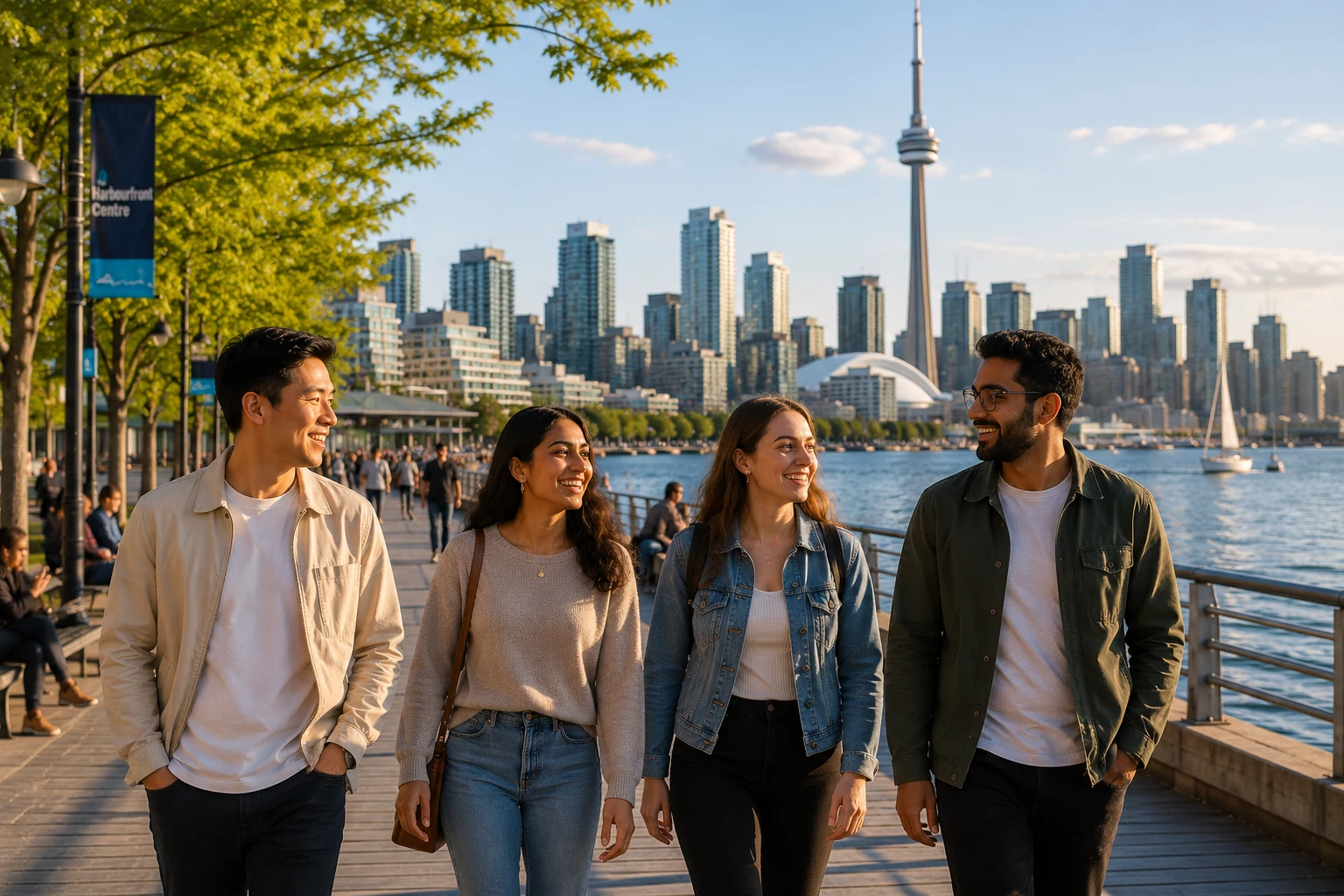
Toronto: A photo in the guide shows Toronto’s business district. The guide calls Toronto “Canada’s financial capital” (see the gallery).
Today: The guide says Canadians enjoy one of the world’s highest standards of living (how well people live). Hard work, and trade with other nations, in particular the United States, keep it high.
Social Programs
Paying for programs: As prosperity grew, so did the ability to support social assistance programs (government help for people in need).
Health care: The Canada Health Act ensures common elements and a basic standard of coverage (what public health insurance pays for).
Employment insurance, 1940: The federal government introduced unemployment insurance in 1940. It is now called “employment insurance.” It pays people for a time after they lose their job.
Old Age Security, 1927: The guide says Old Age Security was devised (planned) as early as 1927. It is a monthly payment to seniors.
Pension plans, 1965: The Canada and Quebec Pension Plans came in 1965. Workers pay into them, and they pay a pension (regular payment) after retirement.
Education: The provinces and territories provide publicly funded education (schools paid for with taxes).
What the guide says, and what is true today
The WTO: The World Trade Organization was created on January 1, 1995. Canada has been a member since that day, and a member of GATT since 1948 (World Trade Organization).
Health care: The Canada Health Act dates from 1984. It is Canada’s federal law for publicly funded health insurance (Health Canada).
Employment insurance: The Unemployment Insurance Act became law in August 1940. The first payments were made in January 1942 (Employment and Social Development Canada). Today’s name comes from the Employment Insurance Act of 1996 (Justice Laws).
Old Age Security: The 1927 law, the Old Age Pensions Act, gave pensions to some people aged 70 and over, depending on their income. In 1952, Old Age Security began paying a pension to everyone aged 70 and over (Library of Parliament).
Pension plans: The Canada and Quebec Pension Plans became law in 1965 and began on January 1, 1966 (Government of Canada).
A growing role: Like Australia, New Zealand and other countries, Canada developed its autonomy (power to govern itself) gradually. It became able to make significant contributions internationally (to the world).
The Cold War
What it was: The Cold War was a long time of tension between the Soviet Union and the democratic countries of the West, without a direct war between them.
How it began: After the Second World War, several liberated (freed) countries of eastern Europe became part of a Communist bloc (group of countries). In a Communist country, one party controls the government and the economy. The Soviet Union controlled the bloc, under the dictator (ruler with total power) Josef Stalin.
NATO: Canada joined with other democratic countries of the West to form the North Atlantic Treaty Organization (NATO). It is a military alliance (countries that promise to defend each other).
NORAD: Canada joined with the United States in the North American Aerospace Defence Command (NORAD). Together they watch and defend the skies over North America.
The United Nations and Peacekeeping
The UN: Canada joined international organizations such as the United Nations (UN).
The Korean War (1950–53): Canada took part in the UN operation defending South Korea. The guide says 500 Canadians died and 1,000 were wounded. Learn the guide’s numbers for the test; the box below says what is true today.
Peacekeeping: Canada has taken part in many UN peacekeeping missions (soldiers sent to keep peace between two sides). Examples are Egypt, Cyprus and Haiti.
Other operations: Canada also took part in other international security operations, such as those in the former Yugoslavia and Afghanistan.
What the guide says, and what is true today
The Korean War: Veterans Affairs Canada says more than 26,000 Canadians served and 516 died.
Afghanistan: More than 40,000 Canadians served there. Canada’s military mission ended in March 2014, and 158 members of the Canadian Armed Forces died (Veterans Affairs Canada).
Peacekeeping today: More than 125,000 Canadians have served in UN peace operations (Global Affairs Canada). Today the number is small: in February 2026, 27 Canadian military staff and police served in UN peacekeeping (United Nations Peacekeeping).
After the war: French-Canadian society and culture flourished (grew strong) in the postwar years.
The Quiet Revolution and Two Languages
The Quiet Revolution: In the 1960s, Quebec went through an era of rapid change known as the Quiet Revolution.
Separation: Many Quebecers sought to separate from Canada (to leave Canada and make Quebec its own country).
1963: Parliament set up the Royal Commission on Bilingualism and Biculturalism. A royal commission is an official public inquiry (study). This one studied Canada’s two languages and two main cultures.
1969: The commission led to the Official Languages Act. It guarantees French and English services in the federal government across Canada.
1970: Canada helped found La Francophonie, an international association of French-speaking countries.
Two Referendums
Sovereignty: The movement for Quebec sovereignty (Quebec as an independent country) gained strength.
1980: Sovereignty was defeated in a referendum in Quebec. A referendum is a vote of all voters on one question.
1982: After much negotiation, the Constitution was amended (changed) without the agreement of Quebec.
1995: Sovereignty was defeated again, in a second referendum.
Today: The guide says the autonomy of Quebec within Canada remains a lively topic (people still discuss it). It is part of what continues to shape the country.
2006: The House of Commons recognized that the Québécois form a nation within a united Canada (the Who We Are lesson).
What the guide says, and what is true today
The results: The guide does not give them. In 1980, 59.6% voted No and 40.4% voted Yes. In 1995 the result was very close: 50.6% No and 49.4% Yes (Élections Québec).
Official languages: A second Official Languages Act came in 1988. Parliament modernized (updated) the Act in 2023 (Canadian Heritage).
More open: As social values changed over more than 50 years, Canada became a more flexible and open society.
School and work: Many people took advantage of growing secondary (high school) and postsecondary (college and university) education. A growing number of women entered the professional work force (jobs such as doctor, lawyer or engineer).
The Right to Vote
Before: In the past, most Canadians of Asian descent (origin) were denied (refused) the vote in federal and provincial elections.
1948: The last of these, the Japanese Canadians, gained the right to vote.
1960: The guide says Aboriginal people were granted the vote in 1960.
Today: Every citizen 18 or older may vote.
Refugees
Refugees: Refugees are people who flee danger in their own country. Canada welcomed thousands of refugees from Communist oppression (cruel, unfair rule).
Hungary, 1956: About 37,000 people came who had escaped Soviet tyranny (cruel rule) in Hungary.
Vietnam, 1975: The Communists won the Vietnam War in 1975, and many Vietnamese fled. Over 50,000 found refuge (safety) in Canada.
Multiculturalism
A new push: Immigration in the 1800s and 1900s gave the idea of multiculturalism (many cultures living together, each respected) a new impetus (push).
One-third: By the 1960s, one-third (one in three) of Canadians had origins that were neither British nor French. They took pride in keeping their distinct (own) culture as part of the Canadian fabric (the mix that makes Canada).
Today: The guide says diversity enriches Canadians’ lives, particularly in cities.
What the guide says, and what is true today
The vote: Elections Canada says Canadians of Asian origin got the federal vote in 1948. Inuit had the vote from 1950. In 1960, First Nations people got the federal vote without losing their status. No law ever kept the Métis from voting.
Origins today: In the 2021 Census, people reported more than 450 ethnic or cultural origins. Immigrants were about one in four Canadians (23%) (Statistics Canada).
Refugees: Parks Canada says more than 37,500 Hungarian refugees came in 1956 and 1957. From 1975 to the end of the 1990s, more than 210,000 refugees came from Vietnam, Cambodia and Laos, mostly from Vietnam (Parks Canada). Learn the guide’s numbers for the test.
Pride in the arts: The guide says Canadian artists from all regions reflect and define Canada’s culture. It says they have achieved greatness both at home and abroad (in other countries).
Writers and Musicians
Literature: Canadians have made significant contributions to literature (books, poems and other writing) in English and in French. Novelists, poets, historians, educators and musicians have had a significant cultural impact.
Men and women of letters (writers): Stephen Leacock, Louis Hémon, Sir Charles G.D. Roberts, Pauline Johnson, Émile Nelligan, Robertson Davies, Margaret Laurence and Mordecai Richler.
Musicians: Sir Ernest MacMillan and Healey Willan won renown (fame) in Canada and abroad.
New voices: Writers such as Joy Kogawa, Michael Ondaatje and Rohinton Mistry have diversified (added variety to) Canada’s literature.
Painting, Theatre and Film
The Group of Seven: The guide says Canada is perhaps best known in the visual arts for the Group of Seven, founded in 1920. They developed a style of painting to capture the rugged (wild and rough) wilderness landscapes.
Tom Thomson: The guide shows his painting The Jack Pine (see the gallery). He painted the wilderness like the Group of Seven.
Emily Carr: She painted the forests and Aboriginal artifacts (objects people made) of the West Coast.
Les Automatistes: This Quebec group pioneered (were among the first to make) modern abstract art (art that does not show real things) in the 1950s. The best known was Jean-Paul Riopelle.
Louis-Philippe Hébert: A celebrated Quebec sculptor (artist who makes statues) of historical figures (people from history).
Kenojuak Ashevak: She pioneered modern Inuit art with etchings, prints and soapstone sculptures.
Theatre: The guide says Canada has a long and respected performing arts history, with a network of regional theatres and world-renowned performing arts companies. It shows a photo of Cirque du Soleil (see the gallery).
Film: The films of Denys Arcand are popular in Quebec and across the country, and have won international awards. Other noteworthy (important) filmmakers are Norman Jewison and Atom Egoyan. Canadian television has a popular following.
Sports
Athletes everywhere: All provinces and territories have produced amateur (unpaid) and professional star athletes and Olympic medal winners.
Basketball: Canadian James Naismith invented basketball in 1891.
Ice hockey: The guide calls ice hockey Canada’s national sport. It says Canadian teams have dominated (been the best in) the world, and many major league sports have Canadian players.
Paul Henderson, 1972: He scored the winning goal for Canada in the Canada-Soviet Summit Series. The guide says it is often called “the goal heard around the world.”
Wayne Gretzky: The guide calls him one of the greatest hockey players of all time. He played for the Edmonton Oilers from 1979 to 1988.
Donovan Bailey: At the 1996 Olympic Summer Games he set a world record as a sprinter (fast runner) and won two gold medals.
Chantal Petitclerc: A world champion wheelchair racer and Paralympic gold medallist. The Paralympic Games are for athletes with disabilities.
Mark Tewksbury: An Olympic gold medallist and a prominent (well-known) activist (a person who works for change) for gay and lesbian Canadians.
Catriona Le May Doan: She won a gold medal in speed skating at the 2002 Olympic Winter Games.
Canadian football: It differs in several ways from American football. Teams in the Canadian Football League (CFL) compete for the Grey Cup. Lord Grey, the Governor General, donated it in 1909.
Terry Fox and Rick Hansen
Terry Fox: He was from British Columbia and lost his right leg to cancer at the age of 18. In 1980 he began a run across Canada, the “Marathon of Hope,” to raise money for cancer research.
A hero: He became a hero to Canadians. He did not finish the run and he died of cancer. Yearly fundraising events in his name continue his legacy (what he left behind).
Rick Hansen: In 1985, Rick Hansen, also from British Columbia, travelled around the world in a wheelchair. He raised money for spinal cord (the nerves inside the backbone) research.
Science and Research
World renowned: The guide says Canadian advances in science and technology are world renowned (famous around the world). It says they have changed the way the world communicates and does business.
Thinkers: Marshall McLuhan and Harold Innis were pioneer thinkers.
Research: Science and research in Canada have won international recognition. They attract world-class students, academics (university teachers and researchers) and entrepreneurs (people who start businesses), in medical research, telecommunications (phones, radio and the Internet) and other fields.
Space, since 1989: The Canadian Space Agency and Canadian astronauts have taken part in space exploration, often using the Canadian-designed and built Canadarm (Part 6).
Nobel Prizes: Gerhard Herzberg, a refugee from Nazi Germany, won a Nobel Prize, as did John Polanyi, Sidney Altman, Richard E. Taylor, Michael Smith and Bertram Brockhouse. The Nobel Prize is a top international award.
Museums and Historic Sites
Museums: Museums show Canada’s history through artifacts, works of art, stories, images and documents. There are museums in almost every city and town.
National historic sites: They are in all provinces and territories. They include battlefields, archaeological sites (places where old objects are dug up), buildings and sacred (holy) spaces.
Find one: The guide suggests the websites of the Virtual Museum of Canada and Parks Canada.
What the guide says, and what is true today
Terry Fox: He ran 5,373 kilometres in 143 days. He had to stop at Thunder Bay, Ontario, on September 1, 1980 (Parks Canada). A future $5 bill will show him (Bank of Canada).
Rick Hansen: His Man in Motion World Tour lasted from 1985 to 1987. He wheeled more than 40,000 kilometres through 34 countries (Rick Hansen Foundation).
National sports: By law, hockey is Canada’s national winter sport and lacrosse its national summer sport (National Sports of Canada Act).
Famous inventions: Canadians have made many discoveries and inventions. The guide lists some of the most famous. Learn who did what: the test asks.
The Guide’s List
Alexander Graham Bell: He hit on the idea of the telephone at his summer house in Canada.
Joseph-Armand Bombardier: He invented the snowmobile, a light-weight winter vehicle.
Sir Sandford Fleming: He invented the world system of standard time zones.
Mathew Evans and Henry Woodward: Together they invented the first electric light bulb, the guide says. They later sold the patent (the right to the invention) to Thomas Edison, who made the light bulb a business success.
Reginald Fessenden: He contributed to the invention of radio. He sent the first wireless voice message in the world.
Dr. Wilder Penfield: A pioneering brain surgeon at McGill University in Montreal. He was known as “the greatest living Canadian.”
Dr. John A. Hopps: He invented the first cardiac pacemaker (a small device that keeps the heart beating regularly). It saves the lives of people with heart disorders.
SPAR Aerospace and the National Research Council: They invented the Canadarm, a robotic arm used in outer space.
Mike Lazaridis and Jim Balsillie: Of Research in Motion (RIM), a wireless communications company. Its most famous invention is the BlackBerry.
Insulin
Banting and Best: Sir Frederick Banting of Toronto and Charles Best discovered insulin, a hormone (a natural chemical in the body) to treat diabetes. Diabetes is a disease of too much sugar in the blood.
Lives saved: The guide says insulin has saved 16 million lives worldwide.
Your Contribution
Working together: The guide says the prosperity and diversity of Canada depend on all Canadians working together to face the challenges of the future.
Your part: When you become a citizen, you join a country that, with your active participation, will continue to grow and thrive (do well). The guide asks: “How will you make your contribution to Canada?”
What the guide says, and what is true today
Insulin: It was discovered in 1921–22 at the University of Toronto. Banting and John Macleod won the Nobel Prize for it in 1923 (Parks Canada).
BlackBerry: Research in Motion changed its name to BlackBerry Limited in 2013.
The Canadarm: It flew on 90 space shuttle missions, from 1981 to 2011. Canadarm2 has worked on the International Space Station since 2001. In 2026 the Canadian Space Agency said it would use its Canadarm3 work for the next phase of exploring the Moon (Canadian Space Agency).
Gallery
Modern Canada
Jump to part
Trade and economic growth
Canada in the world
A changing society
Arts and culture
Discoveries and inventions
FAQs
Frequently Asked Questions
Studying this chapter
Learn who did what: the inventions in Part 6, and the writers, artists and athletes in Part 5. The slides for those parts group them.
Learn the guide’s numbers for the test. The “What the guide says, and what is true today” boxes give today’s facts.
Common mix-ups
No. NATO is a military alliance of Western democracies. NORAD is the air defence command Canada shares with the United States (Part 2).
Both asked Quebec voters about sovereignty, and both times most voters said No. The 1995 result was much closer (Part 3).
No. He became a hero, but he did not finish the Marathon of Hope and died of cancer. Rick Hansen did go around the world, in a wheelchair (Part 5).
The guide says Mathew Evans and Henry Woodward invented the first electric light bulb. They sold the patent to Edison (Part 6).
Related lessons
Practice
Test what you've learned
Answer questions on this lesson without looking back. Recalling on your own helps you remember.
about 3 min for 5 questions
Up next
How Canadians Govern ThemselvesA federal state, a parliamentary democracy and a constitutional monarchy: who does what, how a bill becomes law, and the Sovereign’s role.
🇨🇦 This lesson is inspired by official content from the Discover Canada guide by the Government of Canada.